
Are you looking at ideas for a Christmas getaway but are worried about your carbon footprint? Do you need to take your dog with you? Last Christmas we went for a road trip through France, Switzerland and Northern Italy, taking in lakes, cities, rivers, mountains, cathedrals and castles. We loved it and so did our dog!
I will take you through our itinerary and our experience of travelling through Europe in winter and with our furry friend.

When we think about road trips through Europe we tend to imagine hairpin bends on the Amalfi coast or the lavender-scented backroads of Provence in summer. The idea of a winter car odyssey complete with an alpine crossing seems more complex, and if you add a dog as a passenger perhaps even daunting. We had done winter road trips before, but never with a pet in the back seat, and I admit we were a bit nervous. Still, the lure of the road proved too strong, and we decided to take the practicalities in our stride and give it a try.
The moment we booked our tunnel crossing from Folkestone to Calais, we felt committed – and actually excited – to try something a bit out of the ordinary. Here is what we loved, what we learned, and why we are doing another winder road trip with our dog this year.
Preparing for a winter road trip with a dog
Travelling through Europe by car in winter is undeniably more challenging than in summer. First of all, you have no control of the weather. On your road trip, you may encounter fog, ice, or even snow. So you need to plan while retaining some flexibility. If the alpine tunnel you were planning to use is closed or jammed, you may need to change your itinerary, which may even mean going through a different country.
It is important to be aware of the weather forecasts so you can change your plans if needed. For the same reason, also make sure that the accommodation you book has a solid 24-hour cancellation policy

The other challenge is that night sets in early, so if, like us, you prefer to drivel in daylight – it is easier and you see more -, you will need to plan for shorter journeys or give up lie-ins.
Every European country seems to have their own rules about winter tyres. In France, you need winter tyres or chains in the alpine region; in Switzerland they are only recommended, unless road signs say otherwise; in Italy you need them on the motorways; in Germany winter tyres are not required unless the weather turns snowy, icy or sloshy. So technically you can go from the UK through France, cross the Rhine and enter Italy through Switzerland without needing winter tyres, and with tyre chains in the booth. But if we found ourselves in Germany and found some snow, we may be stuck there. We had tyre chains from a previous trip, but decided to invest in all season tyres before setting off.
The other tricky issue is that while taking a furry friend through Europe is reasonably easy, but if you come from the UK post-Brexit paperwork, rules and costs make it complicated. I have written a post on the topic. Here is also the meantime here is the link to the UK government’s summary of the current rules.
Now, on to the actual journey!
Our winter road trip itinerary
I love summer, but there is something special about travelling before Christmas. And on a road trip through Europe at that time of the year you get to experience the festive vibe in different countries. Winter is also a good time to explore Europe’s cultural and natural highlights without the crowds. And some of the hearty food Europe is famous for tastes so much better when it is cold outside!
After booking our Channel crossing and addressing the practical challenges taking a dog to Europe and travelling in winter (see above), we started to shape the itinerary of our road trip through Europe.
Reaching the cathedral city of Troyes; soaking up the Christmas spirit and Lumières de Noël of Montbéliard’s Christmas market; crossing the Alps and relaxing in the subtropical microclimate of Lake Maggiore; savouring he culinary and cultural delights of Bologna, the food capital of Italy; admiring the Rhine waterfalls at Schaffhausen; enjoying the festive vibe in the fairy-tale Alsatian village of Colmar; and to finish it off in style, a couple of days amongst the beautiful hills of the Champagne region.
When we started the whole of Europe was going through a cold snap, but the travel gods were with us. It was cold but crisp all the way to Lake Maggiore, and the frosty winter mornings made for magical dog walks. And the out of season face of some of Europe’s great attractions repaid our planning efforts.
Here is our travel log!
Our road trip day by day: What did we see?
We got Leia (our dog) settled in her seat, and drove off in the early morning, dreaming of Christmas markets and gothic cathedrals. After the gifts of Brexit (the additional formalities of travel with a dog, passport and custom controls) we drove onto Le shuttle train into the Channel tunnel. 35 minutes later, we were in France! Our first road trip destination was the beautiful city of Troyes.
Day 1 – Calais to Troyes
Because of the 1 hour time difference, by the time we arrived in Calais it was midday. The drive between Calais and Troyes takes about 4 hours, and we had to stop at an autogrill for a bite to eat and to give the dog a little walk, so the sun was about to set when we arrived at our hotel in Troyes.

After freshening up, we went for a stroll through the centre, to admire the gothic architecture after dark, and toast to the smooth start of our road trip.
Troyes is part of the Champagne region, so a celebration with the local sparkling seemed fitting!
The restaurant Grill de Saint Jean was very welcoming to our dog. Troyes is part of a group of tourist locations committed to dog-friendliness, and they even have a dedicated brochure with a list of partner restaurants on their website. The locally-themed food and wines were delicious too!
Over dinner we mused over the history of Troyes splendidly preserved centre. half-timbered. Like the Great Fire of London, a great fire in the early Renaissance destroyed the medieval urban centre, so all houses in the centre were rebuilt at the same time in the same style.
Something is left of medieval Troyes, though – its stunning cathedral and a couple of other churches. We would see those tomorrow.
Day 2 – Troyes
After walking our dog, we set out for the centre again, to visit Troyes’ most celebrated monument. Like many medieval towns, Troyes suffered many fires, and an earlier one at the end of the 12th century. The new cathedral was rebuilt on the same site in the new style that was spreading across France – Gothic.
Although it took four centuries to complete, you would not guess it by looking at it. as the exterior is all in the same style. If the exterior is stunning, the interior literally blows you away. Slender yet might vaulted gothic arches soaring upwards, and 150 sqm off the most famous glass windows in Europe, a triumph of light and colour.

And to add to the charm of the place, outside mass time it was very peacefully, just a handful of tourists admiring the immense space. Mystical in the real sense of the word.
We also visited the museum attached to the cathedral, were interesting objects including relics brought back from a Crusader bishop are kept. By the end, it was lunchtime!
The weather was pleasant and we found an outside table at a patisserie – inside they did not accept dogs – for a quick and delightful lunch of sandwich and flan.
After lunch, we went looking for one of the most photographed corners of Troyes, the Ruelle des Chats (Alley of the Cats). This tiny street, whose upper floors almost touch, is a living example of how tight medieval roads could be. The half-timbered houses of Troyes have beautiful images carved in their woodwork, and if you want an explanation for this alley’s name, look out for the wooden sculpture of a cat! namesake cat in the stonework.

Just around the corner is Troyes’ oldest surviving church, the 12th century La Madeleine, another gothic masterpiece with glass windows and delightful sculptures.
After leaving the church, it was time for some shopping. One of the advantages of a road trip is that the only limit to your luggage is the size of your car’s boot! Champagne and the local Chaource cheese were top of our list, and I also managed to sneak into a bookshop for some reading to keep up my French.
We were lucky with our dinner, as the dog-friendly place we had identified, Comptoir des Halles, only opens for an early dinner at the weekend. We just happened to be in the right place at the right time.
Day 3 – Drive to Montbéliard
The drive between Troyes and Montbéliard is quicker, around 3 hours, so we decided to stop at one of the shopping outlets Troyes is famous for, to pick up some Christmas gifts.
By midday we were on our way. We had only booked one night in Montbéliard, enough time to enjoy the famous Christmas lights (Lumières de Noël). The Montbéliard Christmas market is famous for its quality, all the stalls are vetted and have to sell locally-made and good quality products, so it seemed like the perfect place to look for unique Christmas gifts.
As we could not find dog-friendly accommodation in our budget range in Montbéliard – it is a small town – we booked a stay in nearby Belfort, just 15 minutes down the motorway.
This is were it all went wrong. By the time we had got to the hotel, freshened up, and returned on the motorway, the jams to get into Montbéliard were horrendous. After one hour in the car, barely moving, we realised that it just wasn’t meant to be.
We learned a lesson in Montbéliard. A car is not the best way to get into small town at times when something big is going on. Next time I am most certainly doing by train!

Day 4 – Drive to Stresa
Our failed attempted to get into Montbéliard was the low point of the journey. There was a silver lining though. As we pretty much had a night in, we could set off early the next morning. Given the drive was about 6 hours, by leaving at sunrise – around 7.30 – we could hopefully arrive at Lake Maggiore Accommodation before the evening set in.
You may wonder why I planned such a long drive. The simple answer is that unless you have unlimited time, there will be a couple of days during a road trip through Europe when the driving time is significant. However, if there is a country where a long drive is actually not tiresome, be it winter or summer, it is Switzerland. The scenery is so incredible that you end up stopping a number of times just to admire the views and take photos!
As a matter of fact, the weather was overcast pretty much all the way to Lugano so we did not stop as often as on other trips. That actually turned out to be a good thing. We reached Lugano by lunchtime, and the sun made a promising appearance, so we decided to ignore Google’s instructions -Swiss motorway, border, Italian motorway.
A small part of Lake Maggiore is actually Swiss, and the main centres on the Swiss side of the Lake are Locarno and Ascona. we typed Locarno in Google Maps. In 15 minutes, we hit the lake, and drove around Locarno and Ascona in bright sunshine, before crossing the border at a cute little border booth by the water!

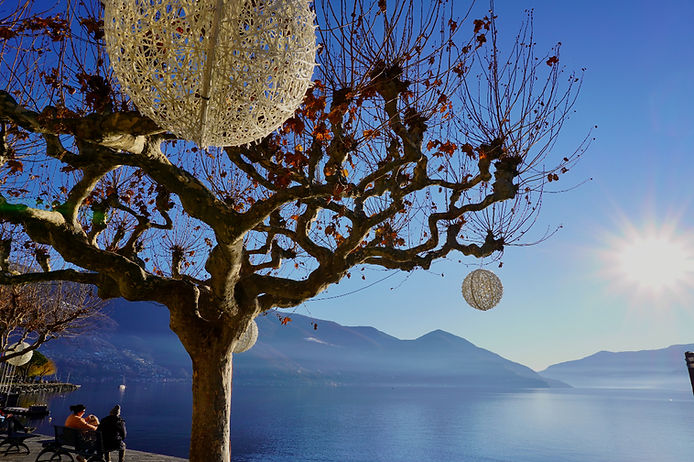
Before reaching our delightful apartment on the outskirts of Verbania, we stopped for a very late lunch in very welcoming pasticceria in Canneto Riviera. The village slopes towards the lake, and past the elegant nineteenth-century villas with their gardens brimming with lemon trees and agaves, we could see the glitter of the water, and we could not resist its pull. We strolled to the shore and as the sun kept playing hide and seek behind some newly-arrived clouds, Leia managed her first Maggiore swim.

We arrived at our apartment at sunset, welcome by the host who offered us a box of organic produce from his vegetable patch and local wine, for a sunset drink in a garden full of orange trees.

Day 5- Lake Maggiore
It was misty in the morning and even when humidity cleared it remained overcast. the ferry to the Isole Borromee does not run in winter, but our plan was to explore the coast without the summer traffic. We went to a coffee shop for breakfast, and then walked through Verbania, to get a feel for the centre and admire the beautiful lakeside villas.
Verbania sits on a promontory and is considered the greenest town on Lake Maggiore, also thanks to the splendid Botanical Gardens at Villa Taranto, which are sadly closed in winter. It also has a good beach were we took Leia for her morning walk – although she decided the morning water was too cold for a swim.

From Verbania we drove 20 minute down the road to Stresa, where we left the car in a parking lot with views of the lake and took a long walk along the Lungolago.
Stresa is considered the ‘pearl’ of Lake Maggiore. After the opening of the Simplon Pass, it became a dream destination for transalpine nobility and artists. Hemingway notoriously spent a few months there, recovering from a World War I injury and writing A farewell to Arms.
Most of the grand hotels were closed, but the beauty of Lake Maggiore in low season is that the locals are really welcoming and friendly when they have more time to look after you, and that human warmth compensates for not being able to go the Grand Hotel’s Hemingway bar for a cocktail. Besides, when the clouds clear, in this heaven of lemon trees and tropical plants, it is very hard to tell the season.
After our brisk walk by the lake, we stopped at an open pizzeria, and discovered some more local wines such as the delightful white Arneis, which I had never tried before.

We had one more destination before the sun set, and it was Baveno. By the time we finished our lunch the last of the clouds had cleared. Like the previous day, the lake was glittering in sunlight, and the Isole Borromee shone in the distance.
Baveno has a delightful hillside centre so we explored that first, and then went back to the Lungolago for yet another stroll.
If you are looking for a party vibe, Lake Maggiore in winter is certainly not the place for you. But we were sad to leave. There are so many hikes and cycling opportunities in the mountains right behind the lake, which also pride themselves on their locally grown produce, cheeses, wines, and hearty dishes.
And we only saw the western (Piedmontese) side of the lake! There are great attractions on the eastern (Lombard) side too! I would love to go back for a whole week, rent a flat and enjoy an away from it all Christmas with sunshine all around me.

Day 6 – Drive to Bologna

The drive to Bologna was not particularly exciting. You drive through the flattest part of Italy, the Pianura Padana, an area the locals like to compare to midwest America for its broad horizons and agricultural vocation. The cities are all incredible, but as we were driving to Bologna there was no time to stop. We arrived in Bologna in early afternoon, just as the roads of the centre started to fill with the unmistakeable smell of roasted chestnuts. I was already in food heaven!
We were staying with friends, so for the first evening we just followed them for a sunset walk along the portici to Piazza Maggiore and the two towers, stopping for hot chocolate and pastries at the delightful Pasticceria Borbonica, After dinner we visited Palazzo d’Accursio, the seat of the Bologna administration, where, under a reinforced glass floor, you can see the excavations of Roman Bologna.
Reaching Bologna, the ‘final’ destination of our road trip, was a turning point. We had made it! From Northern to Southern Europe, through winter, with a dog. Now, we had a few days in Bologna to explore, recover, and celebrate Christmas, and then a different route and destinations to visit on the way back.
To find out how the return road trip went, click here.
If you are planning to travel with a dog, or to drive to Europe, and enjoy my content. subscribe to the blog.
Responses
[…] Check out my post on a Long weekend in the Champagne area for ideas on what to see and do. you can find some recommendations on Troyes here. […]
[…] week I shared the first part of the itinerary (from London to Bologna), as well as our experience of travelling through Europe in winter and with our furry friend […]
[…] Check out this post to plan your visit to Reims and this one for Troyes. […]
[…] You could also visit the less visited but wonderful Aube champagne growing area, and the city of Troyes, with its beautiful medieval centre. […]
[…] Check out this post to plan your visit to Reims and this one for Troyes. […]