
As Europe slowly heads towards the Autumn Equinox, my body starts craving spiced gluhwein and roasted almonds.
Christmas markets are such happy and uplifting experiences, a way to embrace the darkness with the light, the mystical with the Epicurean.
They are a tradition in many European countries, but if there is one country that proudly tops the Christmas market charts it has to be Germany, with the rest of the former or current German-speaking world right behind it. From northern waterside Hamburg to the Bavarian medieval walled city of Hamburg, to historic Aachen and Trier, from large capitals to small towns, each city proudly brings its local uniqueness, making the markets truly special.
All the German Christmas market destinations featured in this article can be reached by train, so you can make your winter celebration gentle to the planet too.

German Christmas markets – an introduction
Weihnachtmarkt and Christkindlesmarkt are the words used in German to refer to a Christmas market. Every city and every village in Germany have One. meandering through stalls laden with marzipan, nougat or ginger-spiced treats, keeping warm with Gluhwein and bright-coloured punsch, you feel like you are stepping into a German fairy tale.
While most of Germany’s Christmas Markets open in late November and close around Christmas Eve some continue until New Year’s Eve, and a few until the Epiphany.
Germany’s best Christmas markets you can visit by train
I have selected the 11 markets for this list with various criteria: Some are in extremely atmospheric historic settings, some in spa towns so you can combine winter pampering and Christmas cheer, and some in cities that are excellent cultural weekend breaks in their own right. I also offered a balance of well-known and lesser-known markets, if you want to go off the beaten path.
Under each listing, highlight the most convenient departure points. To plan and book your trip, you can use Trainline, RailEurope, or Rome2Rio.
Here is my shortlist:
1. Frankfurt’s Christmas Market (Frankfurter Christkindlesmarkt)
What’s so good about it:
It was my first ever Christmas market, so I am biased. It also started with an act of kindness. A local I was chatting to after a work meeting urged me to go. She said was opening that night and proudly added that Frankfurt’s was one of the oldest in Germany. She even gave me gloves and a hat so I could enjoy it!
It was sunset, and I followed her easy directions to the Römerberg, the main square in Frankfurt’s Old Altstadt, surrounded by timbered merchant houses.
A huge Christmas tree stood in the middle. The stalls spilled out of the Römerberg along the main thoroughfare all the way to the cathedral.
I had expected repetitive and boring Christmas-themed souvenirs, and instead discovered beautiful stalls with anything from handmade bags to aromatherapy. The delicious smell of roasted almonds, marzipan sweets, gluhwein and sausages was so tempting I decided to eat at the stalls rather than back at my hotel!

Easy to reach by train from almost everywhere in Europe, Frankfurt’s Christkindlesmarkt is not as famous – and therefore not overridden with tourists – as others can be.
Besides, Frankfurt is an interesting and yet underrated city, which has a lot more to offer than its business centre. Museums, Goethe’s home, the cathedral of Saint Bartholomew, where for centuries the Holy Roman Emperors were elected. You can also escape to the city’s forest (StadtWald), or to the beautiful nearby ancient city of Fulda.
Getting there:
I have written a post on locations that are within 6 hours by train from Frankfurt. If your location is not listed, browse Trainline or RailEurope for travel options.
Dates: Frankfurt’s Christmas market normally finishes just before Christmas Day. In 2024 it runs from November 24th to December 22nd. Check the Frankfurt tourist office’website for details.
2. Aachen’s Christmas Market (Aachener Weihnachtsmarkt)
What’s so good about it:
In 768 AD, after his coronation as King of the Franks, Charlemagne spent Christmas in Aachen for the first time. He fell in love with the place, a former Roman settlement famous for its thermal waters. So, he had his main residence (KaiserPfalz) and his imperial chapel (Kaiserdom), built there.
If you want to soak in the Christmas spirit in the most historical setting, Aachen is the place! From 936 to 1531, Aachen was the site of the coronation of 31 Kings of the Germans, and the coronation spot is still marked on the floor.
No visit to Aachen is complete without stepping into the magnificent Kaiserdom. Charlemagne’s stone throne is still preserved there, and the church is also his final resting place.
The dome of the cathedral, inspired by the Byzantine churches Charlemagne had seen in Ravenna, creates a unique and evocative space.

The dome dominates the cityscape and watches over the Christmas market. The main event of the Aachener Weihnachtsmarkt takes place on the historic Münsterplatz, between the Kaiserdom and the Rathaus.
To continue with the historical theme, the Rathaus (town hall) is built on the site of Charlemagne’s palace and incorporates some of its features.
As you wander about the wooden kiosks, sipping your gluhwein and biting into some Aachener Printen – traditional local Christmas sweets made with caramelised sugar and spices – or a potato fritter (Kartoffelpuffer). you would almost expect Charlemagne to join in the festivities in his the ancient square!
I mentioned that Charlemagne loved Aachen because of its thermal waters. Aachen is still known for its waters, so you can combine the attractions of the Christmas market and the history of Aachen with a real pre-Christmas wellness break.
Getting there:
Aachen is very easy to reach from Belgium, the Netherlands, Luxembourg, London, northeast France, and Lyon.
Dates: Like Frankfurt, Aachen is an Advent market and finishes before Christmas. This year it starts on the 22nd of November and ends on the 23rd of December. Check the Aachen Christmas Market website for details.
3. Trier’s Christmas Market (Trierer Weihnachstmarkt)
What’s so good about it:
Trier is a magnificent city which in the 4th century AD used to be one of the 4 capitals of the Roman empire. It still has Roman buildings such as the famous Porta Nigra (Black Gate), a basilica and even a well-preserved theatre.
Trier also boasts a wonderful medieval cathedral, which dominates the market square. The square is the setting of the Christmas market. Unbelievably, the Trierer Weihnacht is a recent tradition, but you would not notice it if you visit.
Trier’s may be smaller than other city’s markets, but it is very varied, with puppet shows for children, traditional dumplings and sugar-covered pastries (gebäckkringel), and of course mulled wine. Trier in the Moselle region, which produces some of Germany’s best wines, so you can’t go wrong!

Getting there:
Trier is incredibly easy to reach from Luxembourg (one hour away).
It is also a great break from Belgium, the Netherlands and northeast France.
Dates: Advent (November 21st to December 22nd). Check the website for details.
4. Berlin Christmas Markets
What’s so good about them:
The capital of Germany is most certainly also the Christmas market capital of Germany, and probably of Europe. Every area of Berlin has its own. There are over 70 different Christmas markets in the city. So many that visitors can even sign up for a walking tour!
Confusingly, they start and end at different times. Some are local and only last one weekend, whereas the ones in the centre go on throughout the Advent and some beyond.
The most famous of Berlin’s Christmas markets is the Gendarmenmarkt‘s WeinachtsZauber, which this year takes place in the stunning setting of Bebelplatz. It is the busiest of Berlin’s markets, with Christmas carols, shows of acrobats, dancers on stilts, musicians etc.
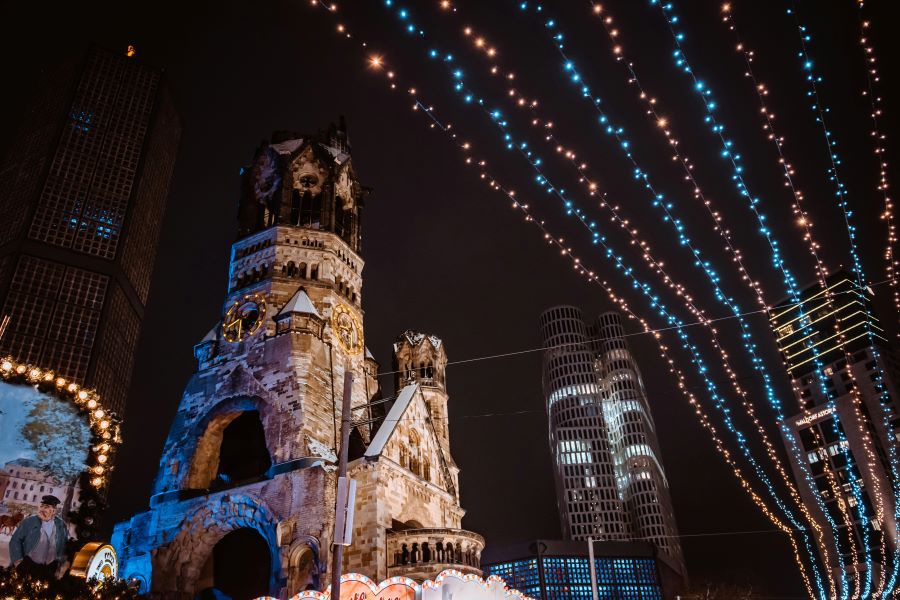
The smaller market around the Kaiser Wilhelm memorial is one of my favourites and very atmospheric.

If you are in West Berlin, Charlottenburg‘s market is magical and a bit less busy. It is set in front of the magnificent Baroque Charlottenburg Palace, and you can stroll through the immaculate gardens as well.
The Christmas lights on Kurfurstendamm are also quite a show.
Getting there:
You can reach Berlin by train from a number of European cities and capitals. Depending on where you are in Europe, you may have great night train options too.
Regular European Sleeper services connect Berlin with Brussels, Amsterdam, Antwerp, and The Hague. Nightjet night trains link Berlin with Paris, Brussels, Graz, Vienna, Budapest, Bratislava, Zurich, Basel, and Warsaw.
If you prefer to travel at day time but feel the direct journey may be too long, you can plan a Christmas markets mini-tour and combine Berlin with another option like Frankfurt or Munich. or a Christmas market outside Germany.
Dates: End of November to end of December, depending on the market. Check the website of the Berlin Tourist office for dates and details of individual markets.
5. Hamburg Christmas Markets
What’s so good about them:
Hamburg is Europe’s second largest port city and used to be part of the Hanseatic League of northern trading cities. Between its history and its waterside location, Hamburg is one of Germany’s most memorable Christmas market destinations. The canals and the Als lakes reflect the Christmas lights, creating a magical atmosphere.
Hamburg takes its Weihnachtsmarkt tradition seriously. There are about 30 Christmas markets in the city, the largest on Rathausmarkt, against the backdrop of 19th Rathaus (City Hall).
The Fleetinsel market, on a tiny island, with the canals glittering around you, is a magical spot. St Petri’s takes place at Hamburg’s oldest surviving church and St Michael‘s by the city’s iconic cathedral.
For the most magical of Hamburg’s Christmas settings, head to the Jungsferstied. There, the iconic floating Christmas tree glitters against the backdrop of the illuminated grand buildings that surround the Binnenalster, one of Hamburg’s lakes. If it freezes, the locals will be skating there too.

Getting there:
The destinations with the best day connections to Hamburg are Brussels, Amsterdam, and Copenhagen.
There are also night trains from Germany, Austria, Denmark, Sweden, and Switzerland.
Dates: Advent to New Year’s Eve. Check the tourist office website for details and ideas. They even recommend a Weihnachtmarkt-themed walking route through the city!
6. Nuremberg’s Christmas Market (Nürnberger Christkindlesmarkt)
What’s so good about it:
The Nürnberger Christkindlesmarkt is arguably Germany’s quintessential German Christmas market, visited by over 2 million people each December.
Said to have started in the heydays of Nuremberg in 1530, its setting in the medieval Hauptmarkt Square, is magnificent.
Wandering through the grand gothic merchant houses, churches and canals of Nuremberg, all glittering in Christmas lights, is an unforgettable experience.
Add to that this city is the home of rostbratwurst and lebkuchen (gingerbread) and you’ll struggle to leave.
Nearly 200 stalls sell gluhwein, hand-carved figurines, folded Christmas angels, and wool garments.

The market gets its name from the holy Christkind (“Christ child”), who is played by a different local child each year and officially opens the celebrations from the balcony of the gothic Frauenkirche, before being paraded through the Hauptmarkt (main market square).
There is so much to see in Nuremberg beyond the market. This city is a gem and makes for a wonderful Weekend getaway, at any time of the year. For ideas of what to do check this post.
Getting there:
Nuremberg is easy to reach by train from Verona, Paris, Amsterdam, Brussels, Vienna, Zurich, and Prague.
There are also night trains from Amsterdam, Vienna, and Brussels.
Dates: Advent. Check the dedicated website for details.
7. Freiburg’s Christmas Market (Freiburger Weihnachtsmarkt)

What’s so good about it:
Thanks to the size of the city, Freiburg’s Weihnachtsmarkt is a memorable market without feeling too busy.
It takes place in the Altstadt, and its heart is the atmospheric Münstermarkt, where the spire of the majestic Freiburger Münster (minster) towers over the stalls.
To add to the fairy tale vibe, many stalls at the Freiburg Christmas Market showcase the crafts and foods of the nearby Black Forest.If you time your visit right, you might see demonstrations by local glass blowers, pastry chefs, and candle makers making the traditional pine cone shaped beeswax candles.
A long weekend gives you the time to explore the Minster, considered one of the masterpieces of the Gothic style, explore the cobblestone streets of the Altstadt, and soak in the great atmosphere of this vibrant university town. To walk off the rich food you can hike the Schlossberg hill, which offers fantastic views of the Black Forest.
Freiburg has been at the forefront of sustainability since the 1990’s and you can hire bikes for free to move around, although you will only need that if you want to venture further afield.
Getting there:
Freiburg is easy to reach by train from Switzerland, Austria, Paris, western and central France, Amsterdam, Brussels, Vienna, Milan, and Turin.
Dates: Advent (November 21st to December 23rd). Check the dedicated website for details.
8. Ravennaschlucht Christmas Market (Weihnachtsmarkt)

What’s so good about it:
Although it is very near Freiburg, this market deserves a separate feature. Imagine a Christmas wonderland of snow and pine trees gathered under railway arches in a mountain gorge in the Black Forest. This dream becomes a reality if you head to the Ravenna Gorge (Ravennaschlucht) Christmas Market.
The stalls under the arches sell Black Forest handmade ware and hearty Swabian food – think smoked pork shoulder and käsespätzle (egg pasta with cheese).
Additional stalls are the nearby Hofgut Sternen Inn, where you could also book an overnight stay, just like Goethe did back in the days.
The Ravennaschlucht market charges a reasonable admittance fee, which also includes the free shuttle. Make sure to book your ticket online in October to secure your admission.
The market has received an official green accreditation from the local Baden-Württemberg government for its commitment to carbon-neutrality.
Getting there:
Get off at Hinterzarten or Himmelreich station and take a free shuttle bus to the market, Freiburg is 14 minutes from Himmelreich and 28 from Hinterzarten. For getting to Freiburg, see above.
Dates: Advent weekends (Friday Saturday and Sunday), from November 28 until December 21. Check the website for details and to book your ticket.
9. Munich Christmas Markets
What’s so good about them:
Munich always knows how to party, and the Christmas market season is no exception.
In Munich, Christmas markets take place all over the city, from Olympia Park to Schwabing to the Nymphenburg but the original one is the Christkindlesmarkt, held in the iconic Marienplatz.
According to local belief, the Christkindlesmart originated in the 14th century.
Nowadays, a giant Christmas tree fills the centre of the Marienplatz, all decked out in her best Christmas lights for the occasion. 150 wooden stalls sell traditional crafts, gluhwein, beer, and Bavarian food, as well as the ubiquitous Christmas market sweets such as roasted almonds coated in sugar, and lebenkuchen.
It is worth wandering off to catch the other smaller but charming Christmas markets scattered all over the city centre. I loved the ones by Munich’s ancient wall towers (Isartor and Siedlingertor).
Next time I am in town I want to try Tollwood, an alternative Christmas market with a sustainable focus which takes place on the Oktoberfest’s grounds.
As so many of the Christmas markets take place right next to the city’s landmarks, combining time in the markets with sightseeing is effortless!

Getting there:
Munich is easy to reach by train from Switzerland, Austria, Paris and most of western France, Amsterdam, Brussels, Vienna, Prague, Verona, and Bologna.
There are also night trains from Amsterdam, Vienna, Rome, Bologna, Milan and Brussels. For connections between Munich and various European cities, check this post.
Dates: Advent (24th of November to 24th of December) Check the tourist office website for details.
Baden Baden’s Christmas Market (Christkindelsmarkt)
What’s so good about it:
I stopped at this market between Christmas and New Year, while driving back from Italy to the UK, and ended up staying 3 days!
During the 19th century, Baden Baden attracted European high society with its thermal waters, and casinos propped up next to the elegant hotels to entertain wealthy visitors. While I have no interest in casinos, I fancied the idea of splitting my time between wellness and Christmas markets, as well as hikes in the nearby Black Forest.
What I found beat my expectations. Baden Baden is a small but extremely romantic city, surrounded by hills, with tree-lined promenades and gorgeous architecture, and a perfect winter break. It snowed every day, which truly added to the magic.
This market is open all the way to the Epiphany, so you can use it as a post-Christmas break, hiking in the hills and enjoying some thermal treatments to start delivering on your New Year Resolutions early.

Getting there:
You can reach Baden Baden from London, Paris, Amsterdam, Brussels, northern Italy, Luxembourg, Switzerland, Austria, Strasbourg, Lyon,
Dates: Advent (27th of November) to Epiphany. Check the tourist office website for details.
11. Heidelberg’s Christmas Market (Weihnachstmarkt

What’s so good about it:
The university city of Heidelberg hosts one of Germany’s most loved Christmas markets.
The hills and castle backdrop help create a magical setting; the atmosphere in the city centre’s elegant cobbled streets and squares is truly vibrant.
This is a market that comes to life at night. That means you can combine your Weihnacht experience with daytime sightseeing – and burn off some calories hiking up to the impressive ruins of the Heidelberger Schloss or on the Philosophenweg!
For my recommendations on what to do and see in Heidelberg, check out this post.
Getting there:
You can reach Heidelberg easily from Paris, Amsterdam, Brussels, Switzerland, Austria, Strasbourg, Lyon,
Dates: Advent (24th of November to 22nd of December. Check this website for details.
To be continued…
My coverage of Christmas markets continues, with a post on the best Christmas markets in Europe outside Germany.
These European winter gems are perfect as city breaks on their own, In some cases, you can design mini Christmas tours of Europe, using the European markets as stopovers en-route to Germany and back.
No time off until after Christmas? These European Christmas markets stay open longer, some of them even until the Epiphany! Even without the magic of Christmas, they can be very atmospheric, and a wonderful way to embrace winter. especially if it snows, like it happened to me when I went to Baden Baden!
To make sure you do not miss the next instalment. subscribe to my blog.
Responses
[…] is the most-loved Christmas market destination, and I have written a post dedicated to my favourite. But there are some great Christmas markets in other European countries too. As an added bonus, […]
[…] but not least, Munich’s Christmas markets are among Germany’s most […]
[…] the viaduct of the Ravennaschlucht (Ravenna Gorge), under which during Advent weekends takes place one of Germany’s most unique Christmas markets. You’ll need to change in Titisee, which is a great opportunity to get off and walk around the […]
[…] Called Aachen because of the thermal waters, the city is also a wellness getaway. During Advent, it hosts a delightful and atmospheric Christmas market, often ranked as one of the best in Germany. […]
[…] Heidelberg is a great winter escape too, as its Christmas market is one of the most celebrated in Germany. I cover it in more detail in my post on the best German Christmas markets. […]