
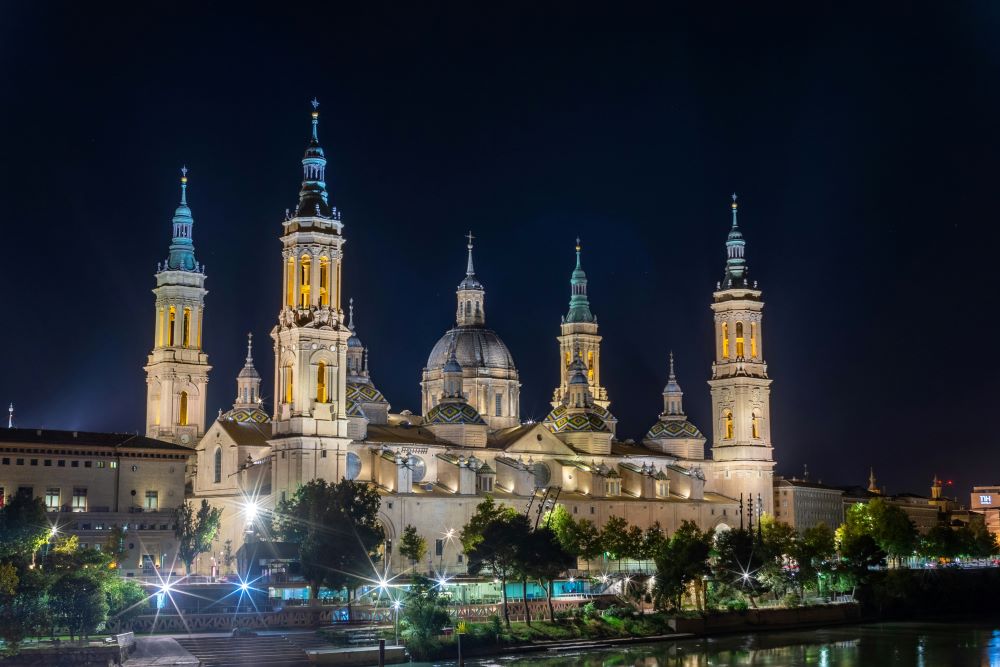
Nothing prepares you for arriving in the centre of Zaragoza. Awe-inspiring is the first word that springs to mind. The sight of the Walls and Domes of the Old City from across a 16th-century stone Bridge is surprising in its Magnificence, and its monuments are testament to the city’s rich and complex history, spanning two millennia.
A short history of Zaragoza

Zaragoza was probably founded in 14Bc, by Emperor Augustus. It was the only city in the empire bearing the full name of the Emperor who founded it. Because of this unique Augustan connection, it is thought that it may have been founded on December 23, To coincide with and Celebrate the Emperor’s 50th birthday.
Born with such unique omens, it flourished into an important Roman commercial and cultural centre. The Remains of the buildings of that Era still give an idea of the importance of Roman Zaragoza.
After the end of the Roman Empire and of its Successor, the Visigothic Kingdom, in the 8th century Zaragoza fell under Arab rule, and became the capital of an important Taifa (principality).This was another golden age for the city, that became a significant intellectual and artistic hub. The palace of the Zaragoza rulers, The Aljafería Palace, a magnificent Moorish fortress-palace, still stands, and is one of the city’s landmarks.
Another turning point in Zaragoza’s history was in 1118, when King Alfonso I of Aragon conquered the city, ending nearly four centuries of Islamic rule. The reconquista brought about a period of significant rebuilding and Christianization. The Romanesque-Gothic La Seo Cathedral, a masterpiece of medieval architecture, was constructed during this time.
under the Crown of Aragon, Zaragoza continued to be a major cultural and economic center. The city’s universities attracted scholars from across Europe, and its artists produced works of great beauty and sophistication.
The Basilica of Our Lady of the Pilar, already a revered pilgrimage site, was expanded and embellished during this period.
In the early 19th century, Zaragoza played a crucial role in the Peninsular War against Napoleon’s forces. The city’s inhabitants, led by General José de Palafox, put up a fierce resistance, enduring two brutal sieges. Although the city eventually fell to the French, its heroic defense inspired the Spanish people and became a symbol of national pride.
In the 20th century, Zaragoza experienced significant industrial growth, particularly in the automotive and textile sectors. to which we owe the significant growth of the city beyond its historical centre.
How to get there
Zaragoza is well connected by fast trains with both Madrid (1h15minutes) and Barcelona (1h23minutes). so you can easily visit for a day trip, if you are in either. But I do recommend staying overnight. With its magnificent sights and lovely tapas cutlure, Zaragoza is a perfect destination to enjoy the magic of a long Spanish evening.
There are direct train from Barcelona to Paris, also stopping at Lyon. If you Are based in Paris or Lyon, Zaragoza could be a perfect flightless long weekend for you!
you can book through Trainline, RailEurope, or RENFE.
10 reasons to visit Zaragoza
There is something magnificent about this former Roman colony founded as ‘Cesaraugusta,’ and still it feels human in size and relaxed. Most of the tourists I saw where Spanish, and the city is not as firmly on the tourist map as it deserves to be.
Perhaps it is better this way. Prices are not extortionist, accommodation and food are of high quality, people are welcoming. I only had 36-hours and wished I had at least one extra day and ideally two, to enjoy this incredible city at a slower place,
So, let me give you a few reasons why you should visit Zaragoza, and ideas of what to see in this under-the-radar Spanish gem:
1. The Ebro

Zaragoza’s river is majestic and one of the city’s most memorable sights. In ancient times, it formed an additional protection for the City Centre – the walls of one of the sides of Roman Zaragoza were running along it.
It had rained when we visited, so the water was more brown than green, but it was still impressive – even more so from the Tower of the Basilica del Pilar! The Ebro also works well as a contrast to the yellow/pale ochre colouring of many of Zaragoza’s brick buildings.
You can also walk along the river all the way to the Aljaferia Palace.
2. The Basilica del Pilar

The Catedral-Basílica de Nuestra Señora del Pilar (Our Lady of the Pillar) is the most majestic building of Zaragoza. Its Baroque domes rising from behind Roman walls are one of the first things you see when you cross the Bridge into the Old City.
The current building dates from the 17th century, but the first chapel built on the site, in about 40AD, is considered the first Church ever built in Mary’s honour. according to tradition, when the Apostle James had travelled to Spain to preach his faith, Mary had appeared to him in a Vision. and had given him a column (‘Pilar’ in Spanish) of jasper, asking him to build a church in her honour. You can still see the pillar in the church, Although it is displayed only on certain days – and it was not on show when I visited.
the church and its cult are considered an integral part of Spanish identity, and you can appreciate that in the devotion you see around you as well as in the masterpieces that surround you. The dome has beautiful frescoes by Goya.

I also loved the exterior, especially the brightly coloured tiles of the roof, which bring such a liveliness to the Magnificent Plaza Del Pilar. I also recommend a visit to the Tower of San Francisco de Borja – don’t be put off, there is a lift – for wonderful views of the Plaza, the roofs of the Church, and the Ebro.
3. Plaza del Pilar
Plaza del Pilar is the Beating heart of Zaragoza. a vast, elegant space, it claims to be the largest pedestrianised space in Europe. While I could not verify that, I can attest to its impressive size.

despite the bustling Tapas Bars Occupying pretty much all of the side opposite the Basilica Del Pilar, it does not feel busy!
The Plaza is surrounded by magnificent Basilicas and palaces. In its middle is a fountain, called Fuente de la Hispanidad. It consists of a ramp with water flowing down it and a pond, which together, from above, take the shape of Latin America. three marble blocks represent Columbus’ ships. The whole scene is a reference to the fact that the Fiesta of Our Lady of Pilar coincides with the day Columbus discovered America.
stroll, people-watch, soak up the vibrant atmosphere and the views. We were lucky to stay around the corner, but do try to come back at night, when the moon paints the roofs of Zaragoza and the paving of the Square. Pure Magic!

4. La Seo

Not many cities can boast Two cathedrals, but Zaragoza does! The Church of La Seo, dedicated to the Saviour (El Salvador) is co-Cathedral with the Virgin del Pilar. a fascinating blend of Romanesque, Gothic, Baroque, and Renaissance styles, with impressive Mudejar elements. it also has stunning stained glass windows, ornate choir stalls, and an impressive Mudejar tower, which offers panoramic views of the city. I spent a lot of time visiting La Seo. The many styles mean that traces of the city’s history through the century are clearly visible in the church, and you do feel like you are inside a book of the history of Zaragoza!

A little curiousity: La Seo lies on the site of a Roman Temple, turned into a Visigothic Church, then a Mosque. After the Reconquista, the church built on the face was made to face north instead of east, as was the tradition of the time. That was not to coincide with the direction of Muslim prayers towards Mecca. Changes were made subsequently…
5. The Roman Theatre
I loved the Roman theatre, and I loved even more the way it is preserved. Surrounded by houses and built over, it was only rediscovered in 1972. It was lovingly recovered, and a glass and metal roof was built over it. That way, the ruins are protected from the damage of the weather while letting natural light filter in.

The theatre dates back to the 1st century AD, the golden age of Roman Zaragoza. You can see the remains of the stage, the orchestra pit, and the seating area.
I also love the fact that its location, off a side Road, is not the most obvious to to find. It all adds to the sense of discovery!
There is also a Museum (Museo del Teatro Romano) and if you have time it seems really worth a visit.
6. The Roman Grid
When you thing of a city’s main attractions, the layout isn’t exactly the first thing that comes to mind. Yet, when thinking about what to see in Zaragoza, it does. Roman cities were typically designed as a grid of intersecting roads. The historic centre of Zaragoza is still its Roman grid. You will see it and ‘feel’ it the moment you arrive. It will be great help in finding your way around. but is also really brings to life the Antiquity of this incredible city!

7. the Aljafería Palace
A magnficent Moorish palace, the Aljafería Palace is the most important relic of Zaragoza’s rich Islamic heritage. built in the 11th century, when Zaragoza was the capital of an Arab Taifa (Principality), it is the closest thing to the magnificent Moorish buildings of Andalucia in Northern Spain. It is also considered the most important surviving palace from the Taifa period (the period of the principalities after the Umayyad Emirate disgregated.

Remarkably, after the Reconquista, the Kings of Aragon did not destroy the Palace of their predecessors but just moved in! That may explain why the Mudejar Christian style of architecture – a skilled mixture of Romanesque, Gothic and Arabic styles – Became so popular in Aragon.
The intricate Mudear interior Contrasts with the stern fortress walls of the exterior, and you will feel like you have entered a treasure box. Amongst the highlights I would mention the throne Room, and the peaceful courtyard gardens.
The palace is now home to the Aragon Parliament, but you can visit it every day of the week.
8. The Mercado Central
The Mercado Central is a bustling market filled with fresh produce, local delicacies, and artisanal products. You can buy treats to take home, or you can enjoy tapas there, in a very atmospheric and lively environment, Around the Corner from Plaza del Pilar.

The building itself is fascinating, an early 19th century creation of Félix Navarro Pérez. The architect employed the materials (glass and metal) and the style of Parisian Modernism.
9. The Roman Walls of Zaragoza
Just by the Mercado Central, you will find some Remains of the Walls of Roman Zaragoza. Cesaraugusta was surrounded by mighty walls – up to 7m metres thick in some parts – and protected by 120 watch Towers.
The surviving Wall, with the enourmous size of its bricks, gives you a good feeling for how impressive the fortification would have been.

Next to this surviving portion of the walls is the Torreon de la Zuda. It used to be the tower of an Arab fortress, The Tower currently houses the Tourist Office, but you are allowed to climb to the Top Floor if you do not make too much Noise.
The top floor houses what is called the ‘mirador de las 4 Culturas,’ because from there you get a 360 degrees view of the city that encompasses the 4 cultures that made it what it is -the Iberians, the Romans, the Arabs and the Christians. I could not see anything clearly Iberian, but the Tower is actually built on the Roman walls and the view of the walls is incredible. You also glimpse the Ebro and of course the Plaza del Pilar.
10. Tapas Tapas Tapas
Zaragoza is a city that knows how to eat and how to drink. Not being overly touristy it also feels very authentic. Wherever you go, you will be rubbing shoulders with locals and eating what they eat.
The areas of Santa Marta and Tubo are the most popular for tapas. But quite frankly there are good places all over, and very reasonably priced.
Although Aragonese Cuisine is strongly meat-based, thanks to the variety of tapas on offers vegetarians will be absolutely fine too.

Make time to discover the traditional Aragonese sweets too. Patisseries will sell you different sweets according the Religious calendar and the Saint of the moment.
Wines are lovely too, especially the red Garnacha (Grenache). The Zaragoza region is considered the world capital for this grape!
if you have more than 24 hours…
There are many museums I wish I had had the time to visit, such as the Goya.
You can also delve more into Zaragoza’s Roman history, by visiting the Museum of the Forum and of the Roman Baths. Another Museu (Museo of the Puerto Fluvial) sheds light on the fact that the Ebro was navigable in Roman times, and the Romans used to send ships up and down the river between Zaragoza and Logroño.
I also discovered that Zaragoza is considered the capital of the Spanish Renaissance, and the closest thing Span had to Florence. Some of the splendid Renaissance mansions of Zaragoza are open to the Public. One houses the Goya museum, but there are a few more I would have loved to visit, given the time, such as the Patio de la Infanta.
Also, with more than 24 hours you can discover some of Zaragoza’s other great Mudejar churches, such as San Miguel and the recently reopened Santa Magdalena.

You can also explore a bit further from the city Centre and discover some of Zaragoza’s magnificent Parks (It is one of the greenest municipalities in Spain), such as the Luis Buñuel Water Park, and the Parque Grande, a modernist park with its fountains and different levels, whic also houses Zaragoza’s botanical gardens.
Zaragoza’s charms will blow you away
Zaragoza is A Spanish jewel without the crowds of Barcelona or Andalucia. The attractions are magnificent, the food incredible, the people friendly and the vibe very relaxed. I Hope I will return soon and discover more of this magnificent city and of Aragon in general!

This article is now featured on GPSmyCity. To download this article for offline reading or create a self-guided walking tour to visit the attractions highlighted in this article, go to Walking Tours and Articles in Zaragoza.
Response
[…] To read more about this stunning Spanish city, click here. […]