
I was driving to Spain in the summer and a friend recommended I stopped in Bordeaux. ‘For 24 hours? I won’t even scratch the surface.’
‘You will,’ she insisted. ‘And more. You’ll love it.’
She was right. Although it will make you want to return and stay longer, even in 24 hours you get a feel for the city – for its charm and its unique energy. And let me add, although the wine was certainly a highlight, Bordeaux offers so much more!
It is a city steeped in history, with incredible architectural highlights, and a beautiful river running right through it. Even if you only have 24 hours, when you arrive you will realise it is not a city you want to rush through, it’s a city you want to savour in the little details. Like with wine, in the city itself, it is quality over Quantity. Less is more!
A quick history of Bordeaux
Once upon a time, There was a Celtic settlement near the mouth of the Garonne river, called Burdigala. the Romans came, saw its potential, and conquered it. The city became an important trading port. especially for metals coming in from the British Isles, and wine and olive oil going in the opposite direction.
The fall of the Roman Empire ushered in a period of turmoil and invasion, from which the city emerged as capital of a Duchy. The port remained important, but the city had to fend off the Arabs first, and the Vikings later.
Eventually the city became part of the Duchy of Aquitaine, and witnessed one of the most momentous events of its history, the marriage of 13-year old Eleanor, Duchess of Aquitaine, to Louis, Heir to the Throne of France.
Eleanor’s marriage did not end well, but Eleanor negotiated herself another husband – Henry of Anjou, heir to the Throne of England. This union created an empire stretching from Ireland to the pyrenees, and brought wealth to Bordeaux. Aquitaine’s wines were exempt from taxation in England, and that spurred a golden age for the wine trade. England’s imports drove the development of more vineyards and the establishment of Bordeaux’s reputation as a premier wine-producing region.
Bordeaux was firmly aligned with the English crown in The Hundred Years’ War (1337-1453). Despite enduring sieges and battles, its strategic importance and economic vitality remained. the French victory ended English rule and returned Bordeaux to French sovereignty.
But the citizens begged to disagree. They created a local parliament, and effectively resisted French Annexation for another 200 years.
The 18th was another golden age for the city, which became a key port in the Transatlantic trade between France and its colonies in the Americas and the Caribbean. coffee, cocoa, sugar, cotton and indigo from the colonies, and the slave Trade, made of Bordeaux France’s busiest port and the second busiest port in the world after London.
The influx of wealth fuelled the construction of grand mansions and public buildings, leaving a shaping the city’s elegant urban landscape.
the upheaval of the French Revolution and the loss of the Loss of the important French colony of Haiti, resulted in the end of the slave trade, and in reduced imports of goods from the America, Bordeaux’s ecoomy suffered. It recovered thanks to the resurgence of its wine industry. The 19th century saw the establishment of the classification system for Bordeaux wines, which continues to shape the region’s wine industry today.
The city continued to be considered so beautiful that when Haussmann redesigned Paris in the 1860’s, he draw inspiration from Bordeaux!
World War I and World War II left their scars on the city. In recent decades, Bordeaux remained one of France’s economic powerhouses, as a strategic hub for the aeronautics, military and space sector. And of course the wine trade is still going strong!, Today, the city’s commitment to sustainable development and environmental initiatives allows the visitors (and the inhabitants) to appreciate the beauty of its historic centre even more.
How to get there
Numerous Fast trains (TGV) connect Paris Montparnasse with Bordeaux. The journey takes just over 2 hours. So, if you have an early start, you could even visit as a day trip from Paris! You can book through SNCF or Trainline.
What to see in Bordeaux in a day
So, here’ are some of the highlights I recommend if you only have 24 hours in Bordeaux. I have not split them into half days, because you may want to adapt the itinerary depending on what time you arrive and where your hotel is. But here is what we managed to squeeze into 24 hours, on a warm Sunday in August.
1. Walk along the Left bank of the Garonne
If you do one thing, do this. A walks Along the left bank from the Pont de Pierre to the Pont Jacques Chaban-Delmas or vice versa. It allows you to Gain a strong first impression of the city. I also feel it is in some way symbolic of Bordeaux’s personality. The Pont de Pierre is Napoleonic; the Pont Jacques Chaban-Delmas opened in 2012 and is a marvel of modern engineering, a reflection of the city’s strong scientific and engineerign heritage).


During the walk you can admire the Elegant 18th-century waterfront mansions and civic buildings (including Place de La Bourse, and relax in the Jardin Public,
I recommend a stop in the Chartrons, the redeveloped Waterfront next to the Pont Jacques Chaban=Delmas. Especially on a sunny day, it is fantastic to sit by the water, sipping a drink or biting into a delicious snack of meal, and watching the world go by. It is a very authentic neighborhood, with locals, children, and dogs.
There are Boat Tours you can take between the two bridges too. But the walk allows you to stop as you please. It also walk gives you the opportunity to appreciate the work done to make the city centre sustainable. There are even bicycle fixing and pumping stations along the Garonne embankment! By the way, if you enjoy cycling, it may be worth renting a bike!
2. Visit Place de la Bourse
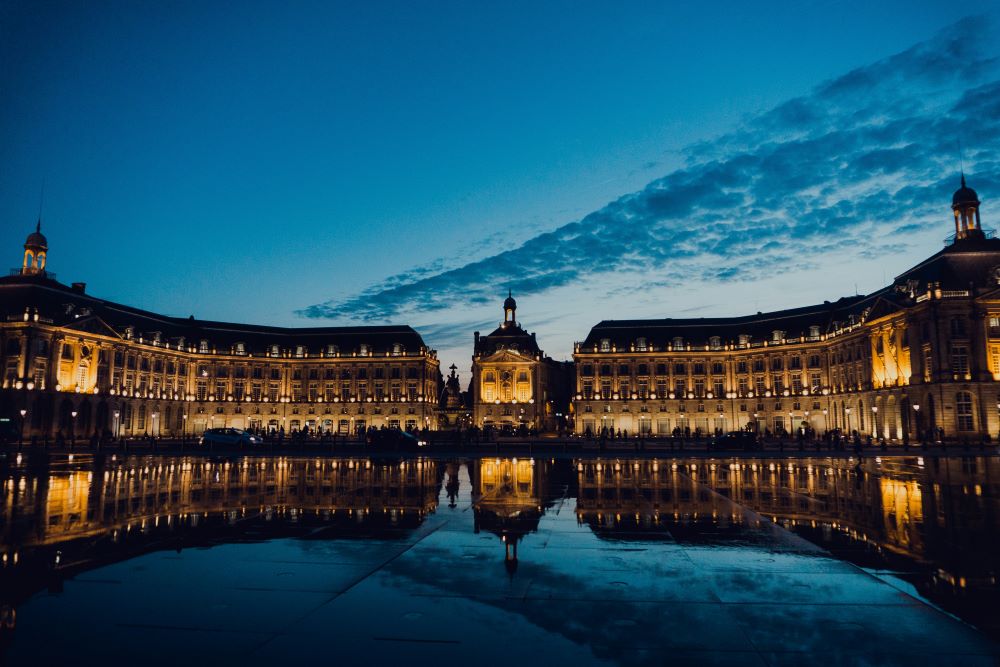
It’s got to be done. This iconic square, with its Miroir d’Eau (water mirror), is pretty much the symbol of Bordeaux, together with the Port Calhau. The square, from the Golden age of Bordeaux, is dominated by magnificent symmetrical neoclassical buildings and has a fountain in the middle.

Then cross, the road. to admire it through the Miroir d’Eau (Mirror of Water). Imagine a large slab of dark stone (granite) whose surface is constantly misted with a fine spray of water, creating a shimmering, reflective effect that changes with the weather and the time of day. Visitors can walk across the wet surface, creating their own unique reflections, or catching the reflections of the buildings in it. Unbelieavably, this iconic feature of Bordeaux was only created about 20 years ago!

A word of warning; If you want a good photo, Go back after dark; the reflection of the water will be easier to capture on camera.

3. Explore the tiny streets of Saint-Pierre
Saint Pierre was the heart of medieval Bordeaux; The street around the church of the same name names bear witness to that.
They remind us of various professions of medieval guilds: rue des Argentiers (goldsmiths), rue des Bahutiers (chest makers), rue du Chai des Farines (grain warehouses), rue Maucoudinat (where seamen’s inns were located), and rue des Trois Chandeliers (candlemakers).

The area’s tiny roads are filled with quaint shops and eateries, and have a very vibrant Atmosphere. You’ll notice stucco peeling off and some buildings need restoration; the slightly decadent grandeur reminded me of Palermo.

The area’s tiny roads are filled with quaint shops and eateries, and have a very vibrant Atmosphere. You’ll notice stucco peeling off and some buildings need restoration; the slightly decadent grandeur reminded me of Palermo.
An unmissable sight in Saint Pierre is the Renaissance gate known as Port Cailhau. Other than the Miroir d’Eau, it is the other iconic symbol of Bordeaux.

built to commemorate Charles VIII’s victory at Fornovo (Italy), the Porte Cailhau was integrated into the city walls, in the part of town where the ducal palace used to be. The There is a magnificent view of the oldest bridge in Bordeaux, the Pont de Pierre, from here.
4. Sip Bordeaux in Bordeaux
It’s got to be done! If you have time, There are wine stores all over the city centre; the owners are more than happy to talk you through the different types of Bordeaux, restaurants and bars proudly offer selections of local wines.
If you want to burnish your sommelier credentials, go to la Cité du Vin: its permanent exhibition helps you to appreciate the role of wine in human culture. Workshops and tasting journeys complement the offering.

5. Discover the gothic wonders of the cathedral of Saint-André:
This vast church with stained-glass windows and a serene interior witnessed the wedding of Eleanour of Aquitaine and Louis of France.
Although we know that a church existed on the same site in Carolingian times, it is at the turn of the millenium that the cathedral really gained in importance. Bordeaux happens to be on the French part of the route to Santiago of Compostela,
The pilgrims brought wealth to the city and its bishopric. The church was rebuilt and expanded in the Romanesque style. The current church was built in the 13th-14th century during the English domination, and the style is mainly gothic.

It is a beautiful and serene sacred building in pale stone, situated in a sunny square. The interior has lovely stained windows and a complex shape, with numerous chapels.
6. Explore the Marché des Capucins
Nicknamed The belly of Bordeaux, this is one of France’s most ancient markets. It was founded by Franciscan monks in the late middle ages. Of course there are tourists, but it remains an authentic experience. The locals come for their groceries, there are also plenty of eateries inside – or you can buy take away food for a picnic in the park.

Bordeaux is not just about the wine; it is also about the food. oysters from the nearby Bay of Arcachon and foie gras are local specialities; vegetarians can be slightly challenged, but Truffle is another popular local ingredient. On the sweet front, I loved canelé, a tiny sweet tasting of Rhum and Vanilla and soft in the middle.
7.Walk along the right bank
The heart of ancient and medieval Bordeaux is on the left bank, but it is definitely worth crossing the bridges and exploring on the right bank too.
crossing the bridges offers fantastic views of both banks of the city from the distance; and walking along the right bank you can glimpse the skyline of the city centre in all its beauty. Secondly, the right bank has some interesting attractions, such as the Jardin Botanique and the tranquil riverside Parc aux Angéliques. The Bastide quarter, a former industrial area recently redeveloped, is both green and vibrant, with a bohemian feel.

If you have more time
If you are staying an extra day, you can either continue to explore Bordeaux and its surroundings, visiting other great ancient churches and museums.
Alternatively, you can:
8. Go on a hike to the surroundings
Anothe great option is hiking or cycling. There is a very long hiking trail that goes all around Bordeaux and connects it with nearby villages and natural highlights, such as the marshes of the Garonne. The trial is 160km long, but you can choose a section that you like based on your interest, and get there by public transport, bycycle of car. You can find more info here.
9. Go on a Day Trip to Saint-Émilion
The picturesque village of Saint Emilion is a great day trip from Bordeaux. To manage expectations, it is not a hidden gem; you will be rubbing shoulders with plenty of other tourists. But it is an incredibly beautiful village. You could go with a tour, but the car gives you the time to explore, and to time your visit not to coincide with the other tour loads from Bordeaux.
Take the time to explore. There are wine caves, but also churches, including one (dedicated to Saint Emilion) excavated in the rock. The village is full of beautiful mansions and cobbled streets, and of course surrounded by vineyards and some of Bordeaux’s great wine estates. There is also a Serene medieval washing fountain.

You will need a car to get there. The station is out of town and although I have read that there is Uber I do not know how reliable it is.
10. Take a day trip to the Dune to Pilat
The same friend who had recommended Bordeaux could not stop telling me about the Dune du Pilat, so I decided to see it for myself. It is frankly very hard to describe. I can tell you that it is the tallest sand dune in Europe, but to comprehend it, you really need to go.
From the visitor centre you follow a well-kept path through a forest, and at the end of the trees, you will make out blistering yellow sand. The climb is steep. When you reach the top, you will be standing ina sea of sand rufffled by the wind, with a sea of tree behind you, and the Atlantic Ocean in front of view. It is an emotion, and a view I will treasure for the rest of my life.

The dune has been in formation for about 4000 years, and you can read about it here. It is one of those places, like the Alps, where as a human, you feel truly humble, and in awe of nature.
This article is now featured on GPSmyCity. To download this article for offline reading or create a self-guided walking tour to visit the attractions highlighted in this article, go to Walking Tours and Articles in Bordeaux
You must be logged in to post a comment.