
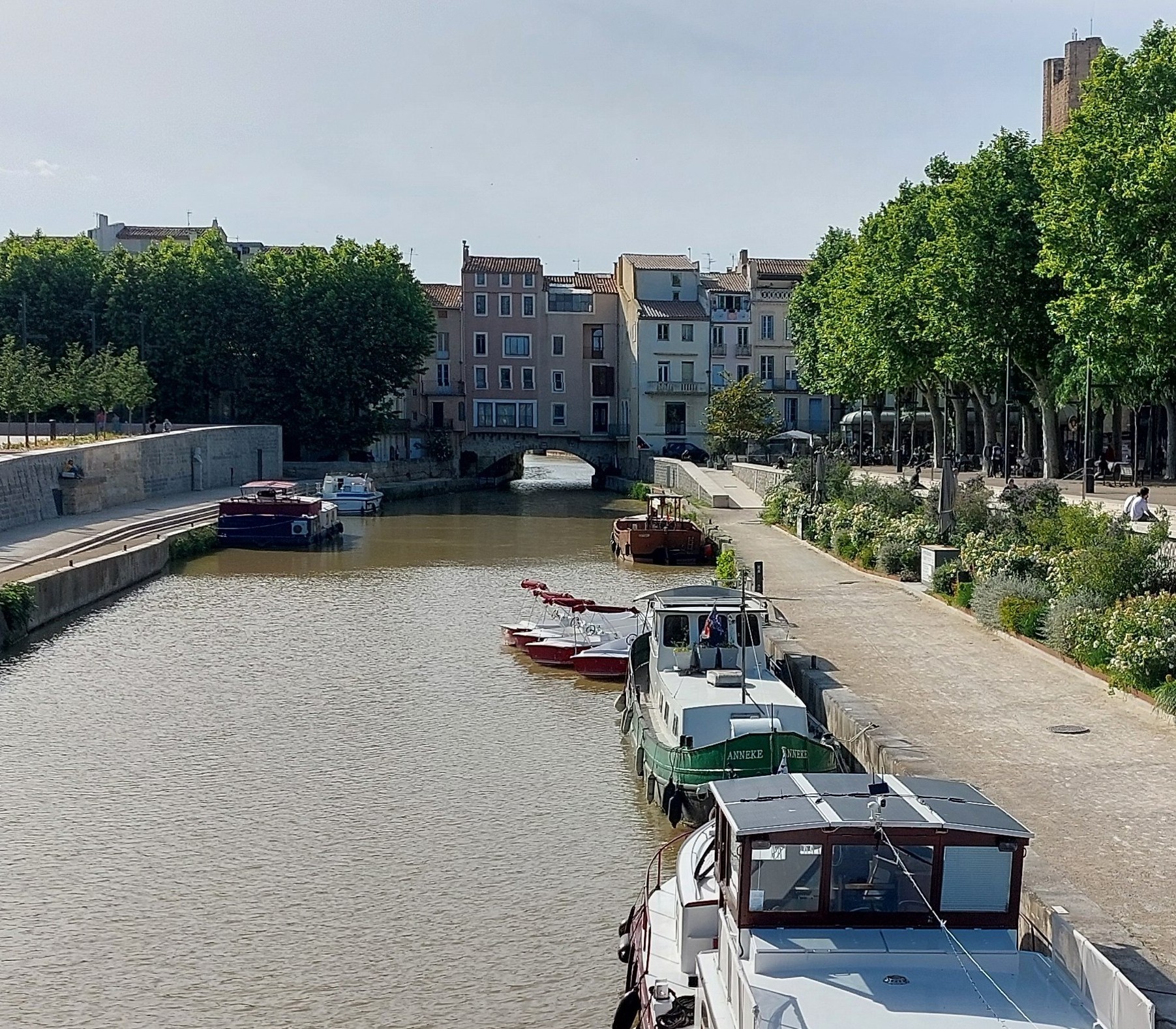
Travellers to the South of France tend to be drawn to the Cote d’Azur and the inland charms of Provence, but I find the corner of Mediterranean France nearer Spain just as interesting.

Narbonne is one of its pearls. With a history stretching 2,000 years, there are plenty of attractions for history buffs. The lifestyle is relaxed, the food lovely and both the Mediterranean coast is just a few km away! The Proximity to Spain is not only Geographical, when I stepped in the main Square the architecture and the outdoor lifestyle evoked memories of Toledo or Zaragoza.
How to Get to Narbonne
The train is the best way to reach Narbonne. The SNCF station is walking distance to the city centre. If you don’t feel like a walk, there are free shuttle buses between the station and the centre too. Check the SNCF website for options, and to book your trip.
In early June, we visited Narbonne as part of our 16-day French Coast to Coast trip with our dog. If you are travelling with pets, a car is a good way to get there. The centre of town is pedestrianised but also quite compact, and there is plenty of parking around it – including some free parking along the Aude. If you need to rent a car, you can compare prices on BSP Auto.
My Narbonne Travel Guide:
A short history of Narbonne
in Roman times, the name ‘Narbonne’ would have been instantly recognisable. In 118 BC, Narbonne, then known as Narbo, it was the first Roman Colony outside Italy.
Located on the Via Domitia, the main Roman Road into Spain, it was a strategic settlement. It grew rapidly in population was was soon embellished by beautiful monuments. In the civil war, it took Caesar’s side, while the other important Gallic port city Marseilles, stood with Pompey. During the imperial years, it remained a prosperous and important city. It may have had 100,000 inhabitants at some point, almost double what it has today.
In the 5th century, at the end of the Roman Empire, it became the capital of the Visigoths’ kingdom. Two centuries later, as the Muslim conquest of Spain spread across the Pyrenees, Narbonne was Conquered by the Umayyad Caliphate of Spain, and then in quick succession by the Franks.
Under the Carolingians, Narbonne developed a very unique identity. Its proximity to Muslim spain meant that a lot of literary and cultural trends of El-Andalus would travel through Narbonne. We also know that Narbonne, like Toledo in the 11th century, Narbonne was a Great centre of Jewish learning. It was also an archbishopric, one of the most important Catholic seats in the Carolingian empire. When the Carolingian power collapsed Narbonne fell under the influence of the Counts of Toulouse. Only from the 16th century it became formally part of the Kingdom of France.
What to see in Narbonne: top Attractions in the city
The cathedral
The Gothic cathedral of Saint Just et Saint Pasteur is quite a unique building. begun in 1272 but never completed, it is built in the style of the cathedrals of northern France. It is a magnificent and complex church, with the side chapels making you feel like it opens in all directions, a bit like an accordion.

The cloisters are beautiful, and the gardens to the side of it are a green and peaceful oasis, with incredible views of the cathedral towers and intricate Gothic features.


The archbishop’s Palace

The three square towers of the fortified Archbishops’ Palace (Palais des Archevêques) are one of the most impressive features of the Narbonne city centre. Built in the 13th and 14th century, when the local archbishop was an advisor the king of France, the imposing building conveys how powerful Narbonne was in those days. The style is very distinctive, More similar in style to a Spanish fortress than to the episcopal palaces of northern and central France.
The courtyard and arches also exude a sense of might, softened by the bright light of its stone,

I did not have time to visit the museum and the rooms, which was a pity as they were offering free guided tours. The square in front of the Palais, Place des Archevêques, with its cafes, restaurants, and shops, feels like the beating heart of Narbonne.

The Via Domitia
In the middle of the Place des Archevêques, you will see what looks like a gap. It is a spot where the original paving of the Via Domitia has been exposed, so you can literally walk on the Roman stones.

The Via Domitia continues through the centre of Narbonne, and it has not been enlarged like Roman roads in other cities. So although the original paving has been covered, and the original buildings replaced, Narbonne is a great place to experience being on a main city road of Roman times..
If you walk in the direction of the Forum Square, A bronze sculpture of the Capitoline she-wolf – a gift from the city of Rome – watches over you .

On the other side, the Via Domitia continues on the Pont des Marchands. The name may sound medieval but the exposed arch is a surviving part of the Roman bridge of Narbonne..
Pont des Marchands – Narbonne’s Roman Bridge
In Roman times, this bridge gave access to the city from the south, where the Bourg neighbourhood is now. Like most Roman Bridges, it had multiple arches, maybe even six, crossing the river Aude, which used to flow through the city. Today only one arch is visible, and it straddles the canal de la Robine – created after the Aude was deviated.

The Canale de la Robine

The Canal de la Robine cuts through the centre of Narbonne, where the river Aude once used to flow. Although much smaller than the Aude had been, as the Pont des Marchands well illustrates, this canal supplied water to the city of Narbonne, as well as the energy needed to operate the mills of the medieval town.
Nowadays its leafy enbankments offer respite from the summer heat, and are a lovely spot for a drink or a bite to eat.
But the canal does not end in the centre. You can walk all along it to Narbo via, and even cycle along it all the way to the Mandirac lock, where you can discover the incredible landscapes of the Narbonnese coast
Les Halles
Facing the centre on the opposite side of the Canal de la Robine, the Art Nouveau glass and steel indoor market is instantly recognisable. It is Narbonne’s foodie heaven. This is the place to come to sample the southern delicacies, from delicious biscuits and pastries, to local olives and wines, from octopus pie to seafood from the Gruissan and Leucate.
Some traders also have outdoor seating so you can try a bite to eat, but the majority of the business takes place inside. Sadly, I never did not manage a visit, but I need to mention it because it is considered it one of Narbonne’s great attractions!
The Horreum
Rediscovered in the 1030’s, the network of underground galleries known as the Horreum (‘Granary’), was probably a large warehouse where the goods destined for Narbonne’s Roman markets were stored.
It is a dark space, which offers respite from the summer heat. The guided route through the part of the complex that has been excavated immerses you in a side of Roman history very distant from the majesty of Fora and ceremonial buildings. Through the various rooms, you get a good appreciation of the complexity of Roman trade and the variety of commodities that travelled across the empire, from wine to textiles. The small museum is also interesting.

Narbo Via Museum

Can you fall in love with a Museum? I did, at Narbo via. Located at the eastern entrance to the city and along the Robine Canal, the Narbo Via Museum was created to house Roman Archaeological collections that were previously scattered in different museums across the city.
The collection is fantastic. The wall frescoes and mosaics from grand Narbonese buildings and villas such as the Clos de la Lombarde are worthy of some of Pompeii’s best.
But the Museum building itself is a contemporary architectural wonder… The exterior is a visionary piece of architecture where sturdy concrete blocks alternate with terracotta bricks, whose colour blends with the surrounding landscape. Native flora ranging from Lavender to vines surrounds the buildings, wisking you back in time long before you enter the stunning Museum space.
In the bright interior, the stand-out feature is the ‘Lapidary Wall’ past the turnstyles. It is an incredible display of Roman funerary sculptures. It separates the public galleries from the restoration spaces. You can glimpse the archaeologists at works through the gaps in the wall. the display is flexible, so the display framework allows the reliefs to be easily reconfigured and used as an active tool for learning.

Amongst the most exquisite exhibits are the mosaics and wall frescoes discovered during the excavation of a patrician house known by the name of Clos de La Lombarde.
The Clos de la Lombarde
To the north of the centre, along the Domitia, in Roman times lay a quarter of grand residential villas. One of them, known as Clos de la Lombarde, has been excavated for a few decades. If you are into Roman history, this is a lovely place to visit, and feel really connected with the ongoing work of the archaeologists. I was a bit unlucky that it was closed both times I tried to visit – the sign said ‘unexpected closure,’ so maybe it was just staff illness. But you have been warned!
Thankfully, as I mentioned above, its magnificent frescoes are now on display at the Narbo Via museum.

Top attractions Around Narbonne
Gouffre de l’Oeil Doux
The Gouffre de l’Oeil Doux, a limestone chasm in the Massif de la Clape, surrounding an expanse of blue green water, is a thing of beauty.
If you are a good cyclist and can do uphills, you can reach it by bike, otherwise you will need a car. There is a parking lot, with decent tree cover, and from there you can hike around the chasm and descend to the bottom.
I strongly recommend doing both. It is magical and despite being only a few kilometres away from Narbonne, you will feel miles away from civilisation!

Gruissan

Gruissan is a postcard-perfect village. Completely surrounded by water, it has a circular shape, its houses hugging the rock and tower in its middle. Its setting is just as special: the scrubland of the Narbonnese interior meets lagoons and the Mediterranean; pink saltpans gleam in the distance, reflecting the terracottta of its rooftops.
Its history is ancient, it used be a port in Roman times; the middle ages left traces in the hilltop tower and castle ruins, and the yellow and terracotta fishermen’s houses, although far more recent, exude Midi charm.
In summer it can get busy, but come in the off season and discover a delightful village!
How long do you need to visit Narbonne?
Narbonne’s centre is very compact and you can get a good feel for it in 24 hours. However, you will need at least 2 or 3 days if you want to visit the main attractions without rushing and even more to explore further afield. We stayed 3 days, and in that time we visited the Gouffre de l’Oeil Doux, and the seaside village of Gruissan, but, for example, could not visit properly the interior of the Archbishop’s Palace, nor the Halles.
To enjoy the area properly, consider at least 4 days, and a week if you want some beach time too.
This article is also featured on GPSmyCity. To download this article for offline reading or create a self-guided walking tour to visit the attractions highlighted in this article, go to Walking Tours and Articles in Narbonne.
You must be logged in to post a comment.