
As many of my readers know, I love medieval architecture, especially castles and cathedrals. I also love discovering destinations that are rich in sights and culture and nature but without the crowds. England’s cathedral city of Winchester is all of those things. People do not take tourists for granted and are truly welcoming and proud of their beautiful city. I have visited a few times, and over the summer I had the pleasure to take a friend who was visiting me from Italy. Despite the whether being a bit touch and go, she absolutely loved it and felt she had discovered something new, a place that no-one else she knew had seen before!
Why visit Winchester?
Do you love the architecture of Oxford but cannot put up with the Harry-Potter-worshipping crowds? Are you looking for that Jane Austen vibe but fancy an alternative to Bath? Are you passionate about medieval and dark ages history? Are you searching for a quintessential postcard-perfect English town, not over-run with tourists and just one hour from London? These are all good reasons to visit Winchester!

A short history of Winchester
The earliest inhabitants of Winchester were a Celtic tribe. After the Roman conquest, the city grew to become one of the most important settlements in Britain. When Rome left, the walled city was occupied by the Jutes and survived as a religious or royal centre, part of the Kingdom of Wessex.
Anglo-Saxon Britain was fragmented in many kingdoms. Under capable leaders such as Alfred the Great, the kingdom fo Wessex (West Saxons) became the most powerful. Alfred, the 9th century king who halted the Viking’s advance, extensively remodelled Winchester, replacing the Roman grid with a more defensive street plan. In Alfred’s time, there was already a cathedral in Winchester, the Church of St Peter and St Paul, later known as the Old Minster. Royal patronage meant that new religious buildings were added, the convent of Nunnaminster, founded by Alfred’s widow Ealhswith, and the so-called New Minster.

It is unclear if Alfred and his successors saw Winchester as the sole capital of their kingdom or as a co-capital jointly with London. Medieval kings were itinerant so they did not have the urge to name a specific capital. But the importance and prestige of Winchester is clear. Coins were minted in Winchester, there was a royal palace, and the royal household did not see Winchester only as a place to visit on prestigious occasions, but also as their final resting place. The remains of the most famous pre-Norman kings are still in Winchester cathedral today.
The Old and New Minster coexisted until the Norman Conquest. King William appointed a new bishop, Wakelin, who decided to replace the two minsters with a single new grand cathedral. The first stone was laid in 1079. After a fire in the city in 1141, Bishop William of Wykeham presided over the restoration of the city and the cathedral, giving the latter the structure we still see today.

During the high and late middle ages, the city was an important centre of the wool trade, before gradually losing importance. It continued to inspire the great minds of English literature, from Jane Austen, who is buried in the cathedral, to Keats, who wrote some of his most celebrated poetry during a stay in the city.
How to get to Winchester
Getting to Winchester from London could not be easier. It is just over 1 hour from the central London Waterloo station! Once you arrive, you will find taxi and buses but the centre is actually walking distance. You can book your ticket in advance on Trainline.
If you are planning to take a number of train trips in the UK in the same year, consider getting a Network RailCard. You will be able to shave 1/3 off the cost of most tickets”
My Winchester travel Guide
How long do you need to visit Winchester?
The centre is very small so you can cover quite a bit in one day – the Cathedral, the Great Hall, and the ruins of the Old Bishop’s Palace, and a short riverside walk. If you prefer an unhurried visit, I recommend an overnight stay. It means you can fit in a hike around the city perimeter, taking in the university quarter, and ideally venture along the river Itchen into the countryside, following in Keats’ footsteps.
The top attractions in Winchester, England
These are my recommended sights in Winchester, if you are going for a day trip or an overnight. I have not ranked them in order, although if you have to pick only one attraction to visit in depth, I would strongly recommend you choose the cathedral.
I have visited Winchester in autumn, spring and summer, and every time I have had a bit of rain. I am not sure if it is a coincidence, but do bear it in mind when you plan. To be honest, with so many lovely places to eat and drink in the quintessential English lanes of Winchester, you will not mind much. It is all part of the experience!
1. Winchester Cathedral
A masterpiece of Gothic architecture, Winchester’s claims to be the longest cathedral in Europe. It does certainly feel majestic when you step inside. Work on the current building started in 1079, not long after the Norman conquest, and continued until the 15th century.
This explains the complexity of the interior, which is well exemplified in the many different types of vaulted ceiling you will notice above you. Some examples are below.


As mentioned earlier, the cathedral is the final resting place of some of the most famous kings and queens of the dark ages, such as Canute the Great, Ethelred the Unready, Emma, and even two of the Conqueror’s sons (King William Rufus and Richard). Alfred and his wife were also been buried in the cathedral, but their bodies were later moved to Hyde abbey and lost during the Reformation. Wikipedia has a useful list of all English royal burials.
Most of the bodies of ancient monarchs in Winchester had been buried in the Anglo-Saxon Old and New Minsters. When the minsters were demolished and the cathedral was built, their remains were collected and placed in six mortuary caskets who now tower above the visitors, almost in direct dialogue with the heavens.

The remains in the caskets are currently being studied to make sure the identification is correct. When I visited, the casket of Queen Emma, wife of Ethelred and the Cnute, had been opened and her bones were being examined. The results of the studies where displayed in a small exhibition on the upper floor of the cathedral. The attribution, based on what we know of her appearance and age at death, seemed correct, and it was incredibly fascinating to witness archaeology in action – and to be confronted with the remains of one of the great ladies of the dark ages, although out of respect I did not take any pictures.
A tomb that attracts many visitors is that of Jane Austen. You will be drawn to the Jane Austen memorial on the wall, in the left nave of the church. But that is just a memorial. Pay attention to the dark slab of stone you may be walking on. This is where England’s most loved author is laid to rest.


2. Prior’s Gate and Cheyney Court
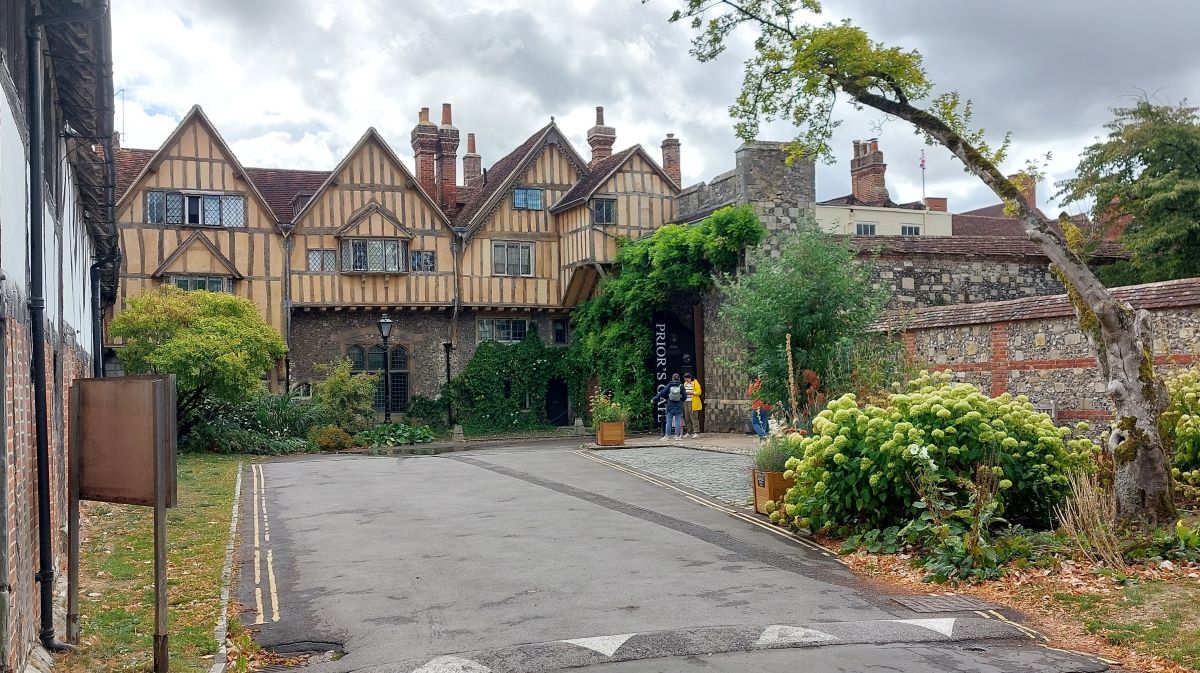
Dating back to the 15th century, Prior’s Gate, at the back of the cathedral, is not just a pretty arch. It also gives access to one of the most photographed corners of Winchester, the delightful half=timbered houses of Cheyney Court.


3. The Great Hall
The Great Hall is sadly the sole surviving part of the magnificent medieval Winchester Castle. William the Conqueror had ordered its construction a year after he seized the crown of England. Most of the structure was supplanted by the adjacent King’s House, which now acts as an Army Barrack. Whilst the castle itself was completed in the 12th century, the Great Hall was rebuilt in its current form in the first half of the 13ths. It is one of the earliest Gothic castle halls, with stained windows, marble columns and beautiful archways.
The Great Hall is a fascinating immersion in the medieval times and their imagination. On one of its walls hangs the mysterious King Arthur’s Round Table. Suggestively, Thomas Malory, in his 15th century poe m Le Morte d’Arthure, identified Winchester with Camelot. We have no evidence of that, however, and the table itself is not from the dark ages, it actually dates from the 13th century, this it is still of considerable historical interest. We know it was originally unpainted, but was painted for Henry VIII in 1522. The names of the legendary Knights of the Round Table are written around the edge of the table surmounted by King Arthur on his throne.

In the grounds of the Great Hall is a recreation of a medieval garden, inspired by two Queens of England accustomed to warmer climates, Eleanour of Provence and Eleanour of Castille.


4. Westgate Museum
The ticket to the Great Hall includes a visit to the Westgate Museum, housed within one of the last remaining medieval city gates. Westgate was initially part of the defence system of Winchester castle. I did not have time to visit, but the views from the top are apparently lovely, and it offers an insight into Tudor and Stuart Winchester.
If it rains, there is a lovely pub across the road, appropriately called The Westgate, if you fancy a lunch or a drink with a view.
5. Wolvesey Castle (Old Bishop’s Palace)
Very soon after the Conquest, the Normans built a castle on the site of an earlier Saxon structure as a house for the bishop of Winchester. Although not an Archbishop, the Bishop of Winchester was one of the most important in early medieval England. The title was coveted and often conferred upon membrs of the royal family, such as Henry de Blois, the brother of King Stephen‘s, who played a key role in the 12th-century anarchy.
In the 16th century, before their wedding the in the cathedral, Queen Mary Tudor and King Philip II of Spain stayed here. The building is now a ruin, but it is a very athmospheric place on the outskirts of the centre, surrounded by greenery and with stunning views of the cathedral in the distance..

6. The High Street and the backroads of Old Winchester
Winchester’s medieval centre is a delight, and you can easily spend half a day exploring the tiny streets, some of the cobbled, between the High Street and the cathedral, getting a feel for King Alfred’s redesign of the city layout. Every corner will be a photo opportunity, and there are plenty of pubs, tea rooms and independent shops to tempt you with their offerings!

7. The Weirs Walk and the River Itchen
For me, one of the main attractions of Winchester is the peaceful river Itchen, that runs through town, from the bridge at the top of the High Street. A path runs along the river and its weirs, and you can can follow iton your way to the Old Bishop’s Palace.

In just a few minutes the urban scene gives way to riverside gardens, while ducks and swans glide peacefully on the waters of the Itchen.
If you are doing the walk en route to the Old Bishop’s Palace, you will eventually have to head inwards along a peaceful road coasting in parts the ancient walls of the city.
8. Keats’ Walk
Apart from Jane Austen, the other literary giant whose soul hovers over Winchester is John Keats. When Keats stayed in Winchester, he used to go on walks along the Itchen far into the countryside, following ancient footpaths that cross stunning natural scenery.

This is where he wrote, amongst others, To Autumn. Every time I go to Winchester I see the sign and ache to set out, but be it the weather or the lack of time, I have never been able to do the walk in full.

We lost a couple of hours because of heavy rain last time I was there, but when the rainbow came out, during our walk to the Old Bishop’s castle, I made a wish. I will return to Winchester and finally do it!
This article is also featured on GPSmyCity. To download this article for offline reading or create a self-guided walking tour to visit the attractions highlighted in this article, go to Walking Tours and Articles in Winchester.
You must be logged in to post a comment.