
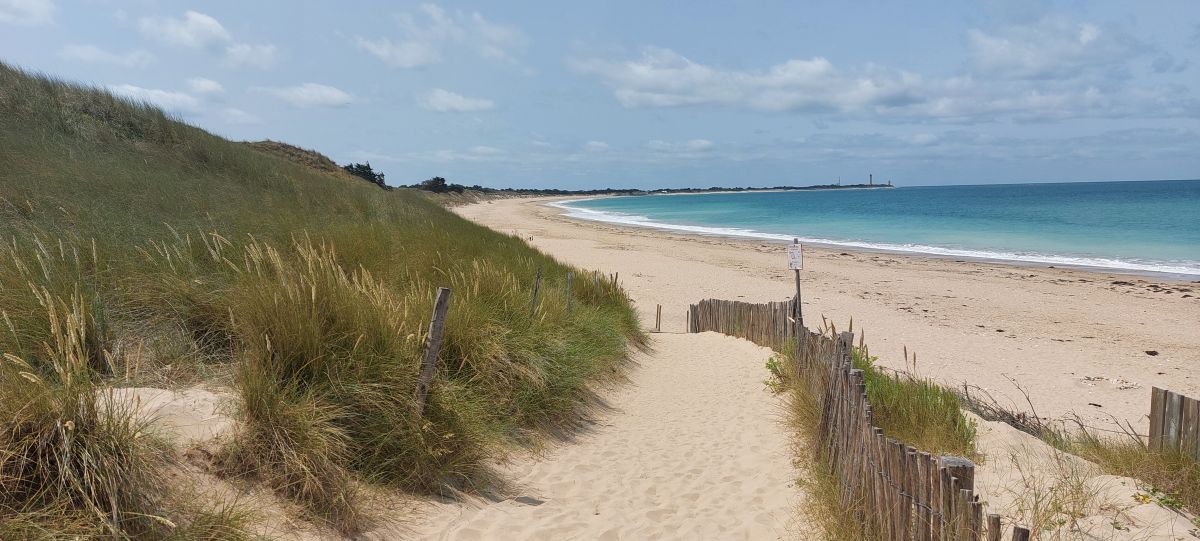
1) Why Go to Île de Ré?
The Île de Ré, or Ile de Re for the Anglophones, is France’s answer to the Greek or Italian islands. Think white washed houses and blue shutters, hollyhocks and bougainvillea tumbling over stone walls, delightful seafood, fabulous beaches, and an abundant dose of joie de vivre. The only difference is that it lies in the Atlantic Ocean (in the Bay of Biscay) instead of the Med, so the climate is cooler and wetter.

While it doesn’t offer almost guaranteed sunshine, it treats visitors to something else very hard to find in the Mediterranean island I visited. Being completely flat, Ile de Re lends itself perfectly to cycling. There is an extensive network of cycling paths, and you can literally leave your car at your accommodation and never use it again!
That alters your sense of time, forces you to slow down. On Ile de Re, your days are set to the rhythm of your feet or your bicycle wheels. Then, there’s the unique beauty of the place – the pretty villages, the timeless charm of its saltpans, the (at times) windswept ocean, the powdery sand under your feet. Everything forces you to live in the moment. And, despite being physically so close to continental France, it somewhat feels remote, a world of its own.

No wonder Parisian celebrities, artists, cyclists, and French families all seem to fall under its spell. Go now before it becomes the new Ibiza!
2) How to Get to Île de Ré
Despite the away-from-it-all feeling, getting there is easy. The Île de Ré bridge, a rather scenic three-kilometre structure, connects the island with the stunning French city of La Rochelle.
The bridge charges a toll, which varies significantly depending on the season, with summer rates being considerably higher than winter rates. You can check the toll for the period of your visit here.
If the toll feels a bit pricy, consider that public transport is free on the island, so you actually recoup your money pretty quickly if you stay a week or so.
The bridge has a dedicated cycling path, so if you come by bicycle you will be immersed in the Ile de Re magic from the very first moment!

Getting to Ile de Re by Car
The drive from Paris takes approximately 4.5 to 5 hours (around 470 km) on the A10 motorway. From Bordeaux it is much shorter, around 2 to 2.5 hours (around 180 km).
When planning your journey, consider that travel time on the island can add up significantly, as the road network is limited. We had booked accommodation on the northern tip of the island, near Portes de Ré. It took us almost an hour to get from the end of the bridge to the top of the island.
It made for a great introduction to the island, though. By the time we arrived in Portes de Ré, we had already seen so many people on bicycles that all we wanted was to rent two wheels and travel like the locals!
Getting to Ile de Re By Public Transport (Train & Bus)
The nearest major train station is La Rochelle-Ville. It is connected to Paris by direct high-speed TGV trains which take about 3 hours. Once in La Rochelle, you can take regional buses. The line 3/3E) crosses the bridge and serves the major villages.
Getting to Ile de Re by Bicycle
You can bring your own bike on the TGV train, or cycle all the way to la Rochelle, You can also hire a bike at La Rochelle-Ville station, This company has great reviews.
If you prefer to rent a bicycle on the island, like we did, it’s absolutely fine too. You will find bike rentals pretty much everywhere, in the villages, in the campsites, and the plein air hotels. I rented directly from my accommodation. And plentiful bicycle parking space too!

3) A Short History of Île de Ré
The Île de Ré boasts a history as rich and varied as its landscape, dating back to pre-Roman times, What is now Ile de Re used to be three distinct islets, which over time, through silting and the development of salt marshes, became one single island.
From its Roman beginning, salt was Ile de Re’s gold, and through the centuries it continued to shape its economy and its history. The Romans also planted the first vineyards.
In medieval times, the island fell under the control of the powerful Duchy of Aquitaine, and briefly, the English, before returning to the French crown.
The 17th century was a tumultuous time, as the island found itself entangled in the French Wars of Religion. Just like La Rochelle on the mainland, the Ile de Re became a Huguenot stronghold, and therefore a key targets for the Catholic crown.
The English intervened, and attempted to support the Huguenot besieged in La Rochelle by taking the island. They laid siege to Saint-Martin-de-Ré, but the French royal forces repelled the invasion. The victory was a crucial step in King Louis XIII and Cardinal Richelieu’s ultimate triumph over the Huguenots.
These events taught Louis XIV the strategic importance of the island in the French Atlantic defensive system, so in the 1680s, he ordered Vauban, his chief military engineer, to fortify the island.
The intricate system of ramparts, moats and bastions of the citadel of Saint-Martin-de-Ré was one of Vauban’s masterpieces, and such an outstanding example of 17th-century military engineering that the Fortifications of Saint-Martin-de-Ré are now recognized as a UNESCO World Heritage Site.

During the following centuries, the island maintained its traditional way of live and industries (fishing, salt farming, and oyster cultivation).
The island’s unique breed of donkeys, known as Anes en Culottes (‘Donkeys in Trousers’) because they were dressed to protect them from insects and marsh mud, are a charming reminder of this agricultural past.
The opening of the toll bridge in 1988 transformed the island’s economy, shifting it towards tourism. But the island succeeded in balancing preservation with prosperity. It is welcoming to visitors, but its natural beauty, historic villages, and quiet charm feel protected. May it stay that way for much longer!
4) Villages, Nature, and Cycling France’s Ile de Re
From the moment you arrive, you will encounter delightful villages and pristine natural landscapes. I was only there for a week, and even that was not enough to see all the beaches and villages. It could have been, if I had rushed around ticking boxes. But Île de Ré is a place you want to savour slowly.
Here are a few recommendations:
Charming Villages:
The island is composed of ten distinct communes, linked by cycle paths. They all have the same, characteristic architectural style – low-built, whitewashed houses with terracotta roof tiles. The pervasise whiteness has earned the iland the nickname of : “Ré la Blanche” (Ré the White). Other elements of the classic Rétois architecture are window and door paint in pale shades of green or blue, in striking contrast with the dazzling white walls and the pink and purple roses trémières (hollyhocks and bougainvillea that climb them.
Many houses in the older villages, like Saint-Martin-de-Ré and La Flotte, date back to the 17th and 18th centuries, built during times of significant growth from the profitable salt and wine trades.
Here are brief descriptions of the villages I have visited and what makes them unique.
Saint-Martin-de-Ré
As the de facto capital, Saint-Martin-de-Ré is the island’s most famous destination, especially because of the UNESCO World Heritage status of the Vauban Fortifications.
I am not a fan of military history but I found it remarkably interesting, as I did not expect fortifications of such a scale on such a small island. The village itself is delightful, with a charming port and postcard-perfect pastel-painted houses.

La Flotte
La Flotte’s history stretches back to the Middle Ages when it was a bustling port, key to the salt trade. The port’s green lighthouse is its most distinctive buildings.

Nearby are also the atmospheric ruins of the 12th-century Cistercian the Abbaye des Châteliers.

Today La Flotte is famous for its marché médiéval (a medieval-inspired market set in a half-moon-shaped square where you can buy local produce.
Portes-En-Ré
This is the village in the north of the island where I chose to stay. It is a delight. Whitewashed houses, a lovely central square with wine bars and shops, and it sits within cycling (and walking) distance of spectacular beaches such as Conche des Baleines.

Ars-en-Ré
Maybe the most unique of all the villages, Ars-en-Ré is easily recognisable because of the striking monochrome of the Église Saint-Étienne spire, which has guided boats since the 15th century. Even the interior of the church is whitewashed and exudes Retois charm.


The centre is gorgeous, all winding streets, green shutters, and abundant hollyhocks.

It is is also near the marais salants (salt marshes), which are of the island’s absolute highlights.
La Couarde-sur-Mer
If all roads lead to Rome, on Ile de Re’ all cycling paths lead to La Couarde-sur-Mer. There is a reason for it, it is located at the narrowest point of the island. It is a charming village, with even more charming surroundings. The splendid Marais Salants (saltpans does not sound as poetic) are on its doorstep!

Le Bois-Plage-en-Ré
Le Bois-Plage is famous for hosting the island’s largest summer market. I cycled there on a day that turned out very stormy and wet, so I did not have a chance to fully enjoy it, but it seemed lovely too,
Beaches and nature:
While the villages are charming, the natural landscape is unique. The island’s coastline is varied, offering everything from windsurfing havens to sheltered, family-friendly coves. Most of the best beaches are located along the south and west coasts, backed by protective dunes and pine forests.
The salt marshes are another wonder, and the forested areasHere are some of Ile de Re’s other wonders:
The Phare des Baleines
Located at the western tip of the island, the Phare des Baleines (Lighthouse of the Whales) is one of the island’s most recognizable landmarks. While whales no longer visit this stretch of the Atlantic, the site is pure windswept magic. Climbing the 257 steps to the top apparently offers spetcacular views, although I did not try. The draw of the nearby Plage de la Conche des Baleines was impossible to resist!

Plage de la Conche des Baleines
The reason why I choose to base myself in Les Portes is that it was near the beach of La Conche des Baleines, and I have to say it was even better than in expected.
I arrived at the Petit Bec end, parked my bycicle in the pine forest, and started my exploration. This is a completely wild beach, and it is immense. A three-kilometre crescent of fine sand, stretching from the Phare des Baleines lighthouse to Les Portes. I went back a few times, taking long walks and relaxing with a book. In early June, on weekdays, I was almost completely along apart from a couple of other visitors and a dog!

Plage du Gros Jonc
I only saw Plage du Gros Jonc on a rainy day, but it is a Blue Flag beach with calm waters, loved by families and watersport entusiasts.

Plage de Trousse-Chemise
This beach in Les Portes-en-Ré, tucked away behind a pine forest, has a serene, untamed beauty. It has a sandbank, the Banc du Bûcheron, which is only accessible at low tide, when people apparently picnic on it! I went twice and I always ended up there at high tide, so I cannot confirm if the picnicing is possible. But the beach is lovely and so is the forest where you park your park to get there!

Plage de la Pergola
This beach in La Couarde-sur-Mer is known as the island’s party beach, so great to visit at night if you are there in season.
Salt Marshes (Marais Salants)
The salt marshes are for me even more memorable than the beaches. Some of the cycling paths take you right through them, and they are a true wonder. When I saw Fleur de Sel Île de Ré sold in shops across the island, I thought it was just a way to indicate premium salt. But seeing the beautiful flowers growing in the salty water of the pans, made me look at the name in a very different way. Loix, Ars-en-Ré, or Couarde are great starting point for exploring them..

Oyster parks
Ile de Re oysters are famous, and you can taste them right next to the beds they grow in! For oyster connaisseurs, Rivedoux-Plage and Ars-en-Ré are the places to be. En route to Ars-en-Ré, you will ride past the vineyards where the grapes of the local white wines are grown. From your eye to your table (or your mouth!)
5) Exploring Île de Ré by Bicycle
The quintessential Île de Ré experience is cycling. The island is crisscrossed by over 100 km of well-maintained and signposted cycle routes, so cycling is often the most logical way to travel. This is one of the few places on earth where cars take a back seat!
Key Cycle Routes
Largely separated from car traffic, the routes often run through stunning scenery, be it coastal stretches, pine forests, vineyards, and salt marshes. You can get a PDF of the cycle routes here.
The path between Ars-en-Ré and the Phare des Baleines is spectacular. It crosses the protected nature reserves and is both wild and idlyllic. Like everywhere on Ile de Re, you can stop and buy Fleur de Sel from honesty boxes on the side of the paths.

I also loved the stretch between Ars Ars-en-Ré and la Couarde Sur Mer, where the saltpans were full of flowers!

Saint-Martin-de-Ré to La Couarde-sur-Mer cuts through the island and has lovely views of vineyards. .
Practical Tips for Cycling
- Rental: Bike shops are everywhere. Most offer baskets, and trailers for children. Electric bikes are a popular option for covering longer distances effortlessly.
- Safety: While the paths are excellent, be mindful of the sheer number of other cyclists, particularly during peak summer months.
- Carrying Gear: You can easily cycle to a local marché in the morning, load your basket with fresh produce, wine, and Fleur de Sel Île de Ré, and cycle to the beach for a perfect picnic lunch!

An Atlantic paradise
The more I visit the French Atlantic Coast the more I fall in love with it. There are many stunning beaches and unique destinations, But Île de Ré is one of a kind. Its blend of architectural charm, stunning natural beauty, unique history, and relaxed lifestyle make it a is absolutely special. You can easily spend a few weeks holed up there, grounding yourself between earth, sea, and sky. I know I could!
We visited Ile de Re as part of a coast to coast road trip between France’s Atlantic and Mediterranean coasts. You can get the full itinerary here.
You must be logged in to post a comment.