
When we hear the expression ‘coast to coast’ we think of the two coasts of the United States. But you can have epic coast-to-coast journeys in Europe too. Last summer, we (and our dog) went on a road trip between France’s Atlantic and Mediterranean coasts. We discovered an incredible variety of landscapes, many cities and villages steeped in history, and of course amazing food and wine! Here is our itinerary.
Our 2-week Atlantic to Mediterranean French road trip itinerary
An admission, before you begin reading. We worked remotely from Narbonne and Ile de Re, so actually we spent 3 weeks in France in total. I have condensed our itinerary from 23 to 17 days, so it can be done over 2 weeks (including 3 weekends).
Day 1 UK to Caen (Normandy)
If you do not want to fly, the ferry is the best way to travel from the UK to France’s Atlantic regions of Normandy and Brittany. A quick look at Direct Ferries will show you that there are both daytime and overnight options. We opted for sailing into Caen (Normandy), and then crossed inland via the Loire Valley to Dordogne, and onward to Narbonne, in the southwest corner of the Mediterranean.
When we travel with our dog, we tend to use Brittany Ferries. Our dog does not like being locked in the car, and the ferries between Portsmouth and Caen have dog-friendly cabins. There are both daytime and overnight sailing. On this occasion, we went for overnight, so we could leave after work on the Friday, check in, board, and wake up in Normandy the next morning!
Brittany Ferries’ dog-friendly cabins are not luxurious, but they are clean, comfortable and reasonably spacious, have their own bathroom, and your furry friend gets treated to a goody bag!
If you are planning to travel with a dog from the UK for the first time, you can check my in-depth guide here.
Day 2 Caen to Amboise (Loire Valley)
After a decent night’s sleep, we disembarked and hit the road. We had set ourselves the target of sticking to route nationales (national roads, marked N on maps) rather than autoroutes (motorways, marked A). Journeys become a bit longer, but what you lose in speed you gain in experiences. One of the charms of France is that the moment you get off the motorway, you start discovering hidden gems everywhere. Villages you may never have heard of before, but that are steeped in history and home to incredible buildings.
Sées is a classic example. When we stopped, I had to look it up on Wikipedia! I had never even heard of it. And yet this village is one of Normandy’s most ancient settlements. It remains a bishopric to this day, with a beautiful Gothic cathedral in local pale stone. It made the perfect coffee stop for us, and we spent an hour exploring the small centre before resuming our journey.


After our break, we drove on to Amboise. The final home of Leonardo da Vinci, and seat of a dramatic mountaintop royal palace, it is is one of the pearls of the Loire Valley.
It was already afternoon when we go there, so we were realistic in our expectations – and selective. As we had been there before, on this occasion we did not revisit the Palais Royal, within whose chapel Leonardo is buried, nor the Clos Lucé – the chateau where he spent his final years. If you stay an extra day, or even half day, they are a wonderful experience and worth a thorough visit!
Instead, we went on a stroll about town, soaking in the atmosphere, climbing up the hill by Leonardo’s abode for magnificent views, and then enjoyed some lovely local white wine over dinner. We had an early start the next day as the drive from Amboise to Dordogne was over 4 hours.

Day 3 Amboise to Dordogne
For hours with a dog can easily become six, if they need to stop for a walk, so we arrived in Milhac, the Dordogne hamlet where we had booked our accommodation, in the afternoon. We were tired from the drive so decided to rest and enjoy the pool at our gite, and when the heat abated we went for a hike in the nearby woods.
I think it’s fair to say that nothing prepares you for Dordogne. There is something magical about the lush countryside, inhabited since prehistory. The river Dordogne itself is simply beautiful, snaking its way through a landscape at times dramatic, at others serene.
The pace of life is slow but stimulating, because every country alley, every stone, seems to hold a hidden gem for you to discover!
And people still seem to have the time and desire for human contact.

Day 4 Dordogne

When researching the trip, I realised to see the area properly, I would have needed a month. I had to make drastic choices.
In my shortlist, I had Rocamadour, the cliffside and clifftop sanctuary dedicated to a black Madonna en route to Compostela, visited by kings and artists throughout the century. It did not disappoint. We parked in the ‘modern’ Rocamadour, which has viewpoints to admire the fairytale ancient village, and from there walked to old ‘Rocamadour’, entering through a medieval arch, climbing ancient stone steps to the sanctuary complex, and eventually reaching the top for sweeping views of the river gorge.
If Rocamadour has by far the most remarkable sacred architecture in Dordogne, when it comes to profane architecture, you are spoiled for choice. Dordogne is a land of medieval castles, one more picturesque than the next. We decided on Roque Gageac because I had fallen in love with images of it. This postcard-perfect medieval village is right on the river. It is a delightful place, with a small and atmospheric church surrounded by lush vegetation, a well-preserved castles with a tower offering dramatic views of the Dordogne valley, and pretty restored medieval houses. It was also a great place to take a boat trip on the river – the boats take dogs too!
Day 5 Dordogne

I mentioned that Dordogne has been continuously inhabited since prehistory. If you are an art lover, Dordogne is where you find the Lascaux cave paintings, probably the pinnacle of surviving prehistoric art.
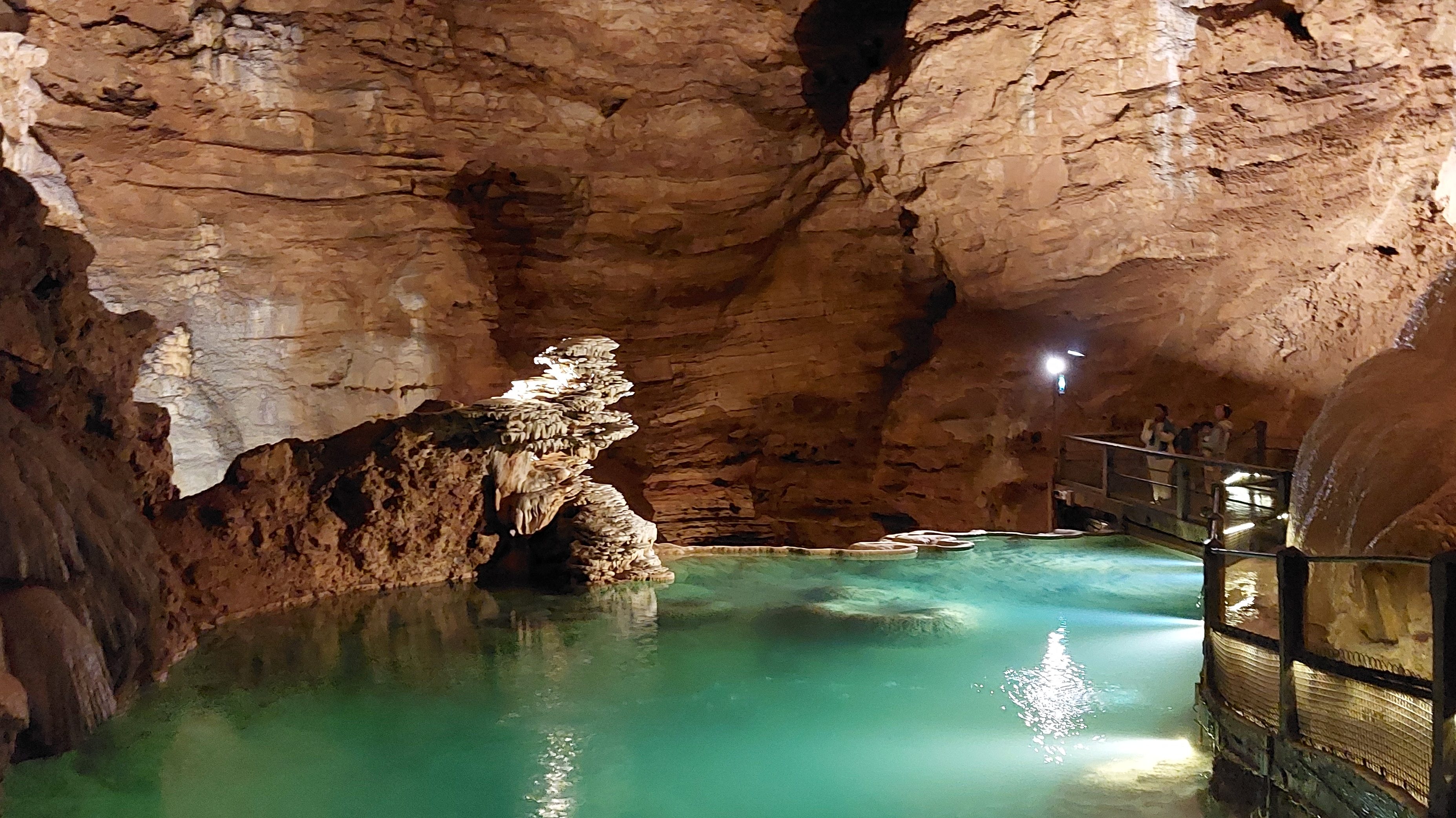
We could not fit Lascaux in, which gives me an excuse to return. But we visited another underground wonder of Dordogne, the Gouffre du Padirac. You descend 100 metres below ground level, and then follow a narrow path through rock, until you reach an area where you board little oar boats. You are then taken on a journey on the underground river Padirac, through a succession of majestic underground caves. It was one of the most unforgettable experiences of my travelling life!
If you are tempted to visit Dordogne, this post delves into my Dordogne itinerary in more detail.
Day 6 Dordogne to Narbonne
The drive from our gite in Milhac to Narbonne took almost 5 hours. We broke it off with a lunch stop in Gaillac, where we went wine tasting within the grounds of the Abbey of Saint Michel. The abbey itself is spectacularly set on a hilltop above the Tarn river. It was a lovely stop in a remarkable historic town, which the French clearly keep to themselves!

We then followed the route nationale through the hills of Occitanie, and arrived in Narbonne in mid-afternoon.
Narbonne is one of France’s oldest cities. While Marseille and Beziers were Greek colonies, Narbonne (Narbo) was the first Roman colony in France. It was also an important town in the Middle Ages, and these historical layers result in remarkable architecture.

We checked into our apartment and explored the centre. The old city is quite small, so we easily took in the main sights from outside and stretched your legs on a slightly longer walk along the boat-lined Canal de la Robine.
Created in the medieval times to divert the course of the Aude river, which caused floods in the city centre, the canal crosses the centre, and is straddled by the Pont des Marchands, part of an ancient (and much longer) Roman bridge over the Aude. We finished your day with an apero in the leafy Cours de la République, the leafy square by the canal, followed by an ice cream in the nearby Place des Archevêques. This is a beautiful urban space dominated by the Archbishops Palace (Palais-Musée des Archevêques). In the centre of the square, archaeologists have resurfaced a tract of the Roman Via Domitia, and you can actually step on the paving, and walk on a real Roman road.
A visit to the Gothic cathedral of Saint Just et Saint Pasteur is a must. Although never completed, it is a large building with beautiful cloisters and gardens. It will take you a couple of hours, but it is well worth it. Do check the closing times and plan accordingly (we visited on a different day).
Day 7 Gruissan, Oeil Doux, and Beziers
As we had the car, on the second day we explored attractions in the surrounding area.
We needed to dip our feet in the Mediterranean somewhere, and I had researched a few villages where to do so. Our host recommended Gruissan, a seaside settlement of circular shape, topped by a ruined castle, and surrounded by water. Set where the scrubland of the Narbonnese interior meets lagoons and the Mediterranean, it is a world of water, sand and earth, with pink saltpans gleaming in the distance. Its history is as ancient as Narbonne’s – it used to be a Roman port, then evolved into a fortified village, and eventually into a cluster of yellow and terracotta fishermen’s houses.
We enjoyed its charm for the best part of a morning, before setting off to discover to a natural wonder in the hills behind Narbonne, the Goufre de l’Oeil Doux. It is a sinkhole in the Clape Massif, surrounded by limestone cliffs and by impossibly green waters. Because of its salinity, and because the water level fluctuates throughout the day, the water is said to come from the sea, although the connection between the sea and the sinkhole has not yet been found.

You park in a forested area and follow a path in the maquis, before descending to the water level. It is a truly beautiful sight, but if you go outside school holidays it can be very peaceful too!
We also spent half a day in Beziers. the city that compete’s with Marseille for the crown of France’s oldest. It was a Greek foundation, and although no buildings from the era survive, the hilltop centre is still known as the Acropole!
Today it has a small but magnificent centre, a blend of medieval alleyways and churches defended by ramparts and of nineteenth-century boulevards.
If you drive in the region, it is definitely worth stopping for longer than half a day to enjoy its authentic vibe as well as magnificent sites.

Day 8 Narbonne


The next day, we were back in Narbonne, looking for the Roman roots of the city – if you need proof of its historical importance, the city of Rome gifted Narbonne a she-wolf to mark the 2000 years since its foundation. Being passionate about Roman history, I visited the beautiful Narbo Via Museum on the outskirts of the centre, the underground Roman Horreum (a granary and storehouses complex). The Archbishops’ Palace (Palais-Musée des Archevêques), seemed incredibly interesting too, I simply could not fit it in. But you can maybe skip the Horreum (which is a bit ‘specialistic’) and visit the palace instead. It is a fascinating building even from the outside, with its yellow stone and mighty towers, archways and courtyards. With an extra day, I would definitely have stepped in!
After 3 days in and around Narbonne, it was time to say goodbye to the Mediterranean and cross France again, this time following the Pyrenees, heading for the city of Toulouse and then back to the Atlantic coast.
The itinerary continues next week
The second part of my French Coast to Coast itinerary will be published next week.
Subscribe to my blog or keep an eye on my social channels so you won’t miss it.
You must be logged in to post a comment.