
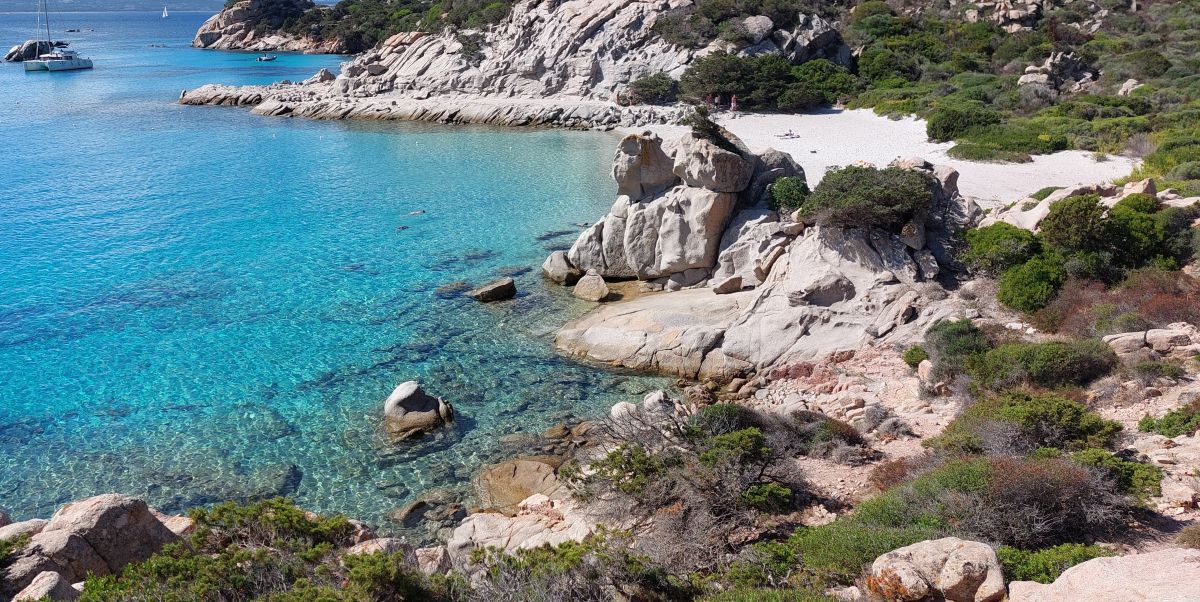
Planning a Sardinia 10-day itinerary? As it is the second-largest island in the Mediterranean, any Sardinia road trip requires choices and some planning. In this guide, I share my exact North Sardinia itinerary, taking you from the magical artists’ village of San Pantaleo to the Maddalena Archipelago (of Pink Beach fame), to the stunning coastline around Santa Teresa di Gallura and south of Olbia. Tempted but worried about the crowds? The weather was gorgeous in early October!
When is the best time to go to Sardinia?
I have visited Sardinia as early as April and as late as mid-October. If you are after nightlife, then you should go from mid-June to early September. But that is also the time when the island is at its busiest – roads are packed, and everything is more expensive.
I love the off-season. Spring comes early to Sardinia, and the brightness of sandy beaches really helps you shake off the winter gloom. June is glorious, with long evenings and great daytime temperatures. Autumn is my favourite, though. You will need a jacket in the evening, but during the day, you can still enjoy the beaches, and the water, still warm from summer, is perfect for long swims.
In early October, the weather in Sardinia is great. Daytime temperatures are in the mid to late twenties Celsius, perfect for enjoying the beach. It can at times be cool in the evening – if the wind blows, you may need a jacket for al fresco dining. As for the sea temperature, after collecting the summer heat, it is lovely and warm!
A short history of Sardinia
Inhabited since prehistory, Sardinia was home to a mysterious Bronze Age civilisation, about which little is known. They were the builders of the nuraghi, the mysterious conical structures you can see all over the island. The Phoenicians came next, establishing trading bases on the island, such as Cagliari.
The Romans followed, of course, and when the empire collapsed, the island changed hands a few times – the Vandals, the Byzantines and then the three great western Mediterranean trading powers – Pisa, Genova, and Aragon – all left their mark on Sardinia during the Middle Ages.
The Aragonese lasted the longest, and the island became part of the Spanish crown until the 18th century, when it passed to the Savoy dynasty and, with Piedmont, became one half of their kingdom. When the Savoy dynasty succeeded in unifying Italy, Sardinia became part of the Italian state.
My North-East Sardinia itinerary
When visiting Sardinia, no matter how long you have, you will need to make choices. The island is large, its interior, green and mountainous, is fascinating, and the coastline boasts so many stunning beaches, bays and promontories that you would have to stop every five minutes.
You can visit Sardinia by public transport – I have done it – but you will have to be very organised. A car makes a big difference, allowing to discover more remote locations, and giving you more flexibility with times. It is also a great way to discover the interior.
Car rental can be expensive in Sardinia, so it makes sense to use a well-respected comparison platform such as Discover Cars.
Day 1 – Arrive in Olbia
We booked an evening flight to Olbia and landed around 9 pm, picked up our hired car, and drove for about 45 minutes toward the La Cugnana massif and the village of San Pantaleo.
It was well after dark when we arrived, so we checked in and found a pizza place for dinner. Our pizza was to die for, on a terrace still busy with locals, and the late-summer breeze re-energised us. We went for a stroll around the tiny centre. Maybe it was the oleanders, and the macchia-scented air, but it felt magical.
San Pantaleo is known as an ‘artists’ village, and the small side streets around its single piazza are dotted with arts and crafts shops, and drinking and eating places.

The proximity to Costa Smeralda means an upmarket clientele – there is even an Art Basel outpost in town – but if you are after an authentic experience, you can easily have that too. It’s a good place to dream about doing something different with your life!
Day 2 – San Pantaleo and Costa Smeralda
We were up early to make the most of our morning in San Pantaleo, which looked even prettier in daylight, with its brightly coloured houses and its abundance of flowers. With mountains around it, it would make an ideal base for hiking and appreciating the magic of the Sardinian interior. If you have the chance to stay longer, it would be worth it.


Our plan was a slow, leisurely drive along the Costa Smeralda, with a few stops along the northern Sardinian coast, arriving in Santa Teresa di Gallura in the evening. Between San Pantaleo and Porto Rotondo we drove, without knowing it, on a road used in a James Bond scene. We continued on via Porto Cervo and Baja Sardinia, then followed the coastal road, with stunning distant hills to our left, and either coastline or Vermentino vineyards to our right, with the Corsican outline rising across the sea.

There is something epic or otherworldly about Sardinia, and this sensation is at least in part due to the local rock. Every moment, you feel like some mythical creature could appear, and it would not feel out of place. Despite the luxury price tag, nature is free in Costa Smeralda, and the sea was so inviting.
We had our first swim before the weather turned, treating the countryside to a welcome downpour. We used the rain as an excuse to stop for some groceries, and by the time we arrived at our accommodation by Marmorata beach, outside Santa Teresa, the sun was out again, and we enjoyed a beautiful sunset on our seaview terrace.

Day 3 – Santa Teresa
I chose Santa Teresa because it was supposed to be more authentic than the villages of Costa Smeralda, with an interesting history and stunning beaches, including one in the city centre! It is called, for a reason that will immediately become obvious if you visit, Rena Bianca (‘white sand’).

Santa Teresa is also the departure point for the ferries between Sardinia and Corsica.
Before descending to the beach, we visited the town centre. With its strategic position, it was a port settlement in Roman times, but the area remained rural during the Middle Ages. In the 17th century, the Spanish rulers built a coastal tower, Longosardo, which is still standing, in a dominant position with sweeping views of the Straits of Bonifacio.
In the early 19th century, the King of Piedmont-Sardinia decreed the building of a town in honour of his wife Maria Teresa, in the area of the tower of Longosardo. Today, the typical Galluran pastel houses make this small town interesting to walk around. Other than the tower, Santa Teresa does not have memorable architectural landmarks. But it is a relaxed and slightly bohemian village, with lively streets, an array of restaurants, bars and gelaterie – and of course the stunning sea views!
After lunch, we could no longer resist the draw of the water, so we descended to Rena Bianca for a relaxing afternoon.
Day 4 – Santa Teresa di Gallura
It was windy the following day, so we followed our host’s recommendation and headed to Capo Testa. After Santa Teresa, just follow the signs, we were told. The road goes through a thin strip of sand before a headland, so you have beaches on both sides. Normally, if one side, say Rena di Ponente, is windy, the other side, Rena di Levante, won’t be. If the drive through the beaches wasn’t spectacular enough, the actual headland of Capo Testa is pure magic – and quintessential Sardinia.

You’ll park the car in one of the parking spots on the side of the road and then head to the Capo Reserve area, where you can only proceed on foot. The view from the top is incredible, as you are on the northwest tip of Sardinia, so you take in some of the south coast, as well as the omnipresent outline of Corsica. To the side of the promontory is a steepish path that takes you down to a series of delightful rock pools of Capo Testa. Nature generously offered us some shelter from the sun, in the form of the shade of a granite boulder, so we placed our beach towels there and enjoyed swimming between the coves.

Day 5 – Travel to La Maddalena
I was sad to leave Santa Teresa, I feel like we only scraped the surface of that beautiful part of Sardinia. I was also looking forward to the next leg of the trip, discovering the small archipelago of La Maddalena, that lies between Costa Smeralda and Corsica.
Many people visit la Maddalena archipelago on a boat tour from mainland Sardinia – we could even have done that from Santa Teresa. The tour takes you through the main islets, and stops in front of the famous ‘pink beach’ of Budelli – tourists are no longer allowed to disembark, to protect the fragile environment.
But I wanted the experience of being on a small island and of discovering la La Maddalena ( and nearby Caprera) independently. Besides, the idea of boarding a small ferry between Palau and La Maddalena felt like an adventure in itself.
We drove leisurely along the coast and arrived in Palau in the late morning, following the signs for the La Maddalena ferries. In October, there was a crossing every 30 minutes, and no need to book in advance to take the car across. If you travel in high season, it probably makes sense to book the car crossing in advance, to avoid disappointment. The cost of the crossing is very reasonable. We paid 35 euros for a return ticket. You do not need to arrive hours in advance, half an hour seems reasonable in case the ticket booths are busy – they were when we crossed.
Boarding takes perhaps another 10 minutes. The crossing itself takes about 20 minutes, literally the time to have an espresso on board and take some pictures. The moment we parked the car on the deck and climbed to the passengers’ hall, I knew we had made the right choice. The islets of the archipelago scattered across the sea, were golden in the sunshine, full of promise.
The town of La Maddalena has the typical Italian seaside feel – an ancient port town with 1970’s buildings rising around it. Maybe not architecturally spectacular, but a relaxed cluster of pastel-coloured houses bathed in beautiful light.
For such a remote location, La Maddalena can boast a remarkable history. A Roman trading outpost in the Straits of Bonifacio, it was virtually abandoned in medieval times, apart from a few monastic communities seeking a quiet and isolated life. After being contested between Pisa and Genoa, it fell under the influence of the Kingdom of Piedmont-Sardinia and witnessed Napoleon’s first military expedition. He took part in an attempt to seize control of the island, but it failed. Nelson came next, using the island as a base for his campaigns against Napoleon. So, unsurprisingly, there are still remains of military fortifications scattered along the island. Besides, La Maddalena is now an important base of the Italian navy.
There is no real beach in town, but after checking into our accommodation, we went for a long hike along the island and spent the afternoon at the incredible Testa di Polpo beach. Testa di Polpo is effectively a separate islet connected to La Maddalena by a tiny road. It has crystal-clear, shallow waters, an away-from-it-all feel, and a forest of rock boulders.


On the way back from Testa di Polpo, we chatted to some of the tour operators about options for boat tours the next day. Unfortunately, the weather forecast wasn’t great, so we did not pre-book, but postponed our decision to the morning. In the meantime, we got to enjoy a stunning Maddalena sunset from our roof terrace.

Day 6 – La Maddalena
The weather was clearly worsening when we woke up, and the boat operators were open about the fact that things would get worse in the afternoon. But when you don’t have many days, sometimes you have to take your chances.
We booked the ‘classic’ Maddalena Archipelago National Park boat tour from the islet of Spargi to Budelli and Santa Maria.
The weather was good in the morning, and Spargi, an uninhabited circular islet rimmed with powdery beach coves, such as Cala Corsara, is a paradise. We spent most of the morning there, swimming and hiking along the coast. With more time, or your own boat/dinghy, it is definitely worth more time.

It was harder for me to appreciate the magic of the celebrated Spiaggia Rosa (Pink Beach) of Budelli, because from the distance, and under what by then was a very grey sky, the sand didn’t look too pink. What I did appreciate is the fragility of the ecosystem, and the sheer beauty of the archipelago.

We could snorkel and swim in the Piscine di Budelli, before heading for Santa Maria, under an intensely dark sky. The weather only improved as we disembarked some fellow travellers in Palau. A rainbow even appeared, which boded well for the next day!
Day 7 – La Maddalena
In the morning, we went for a coastal drive around La Maddalena, 20 km of blissful coastal scenery, with coves, impossibly blue waters. We also crossed through the mountainous interior for vistas of la Maddalena and the whole archipelago from the top. The interior deserves a long hike, to enjoy the views at a slower pace. and look for the ruins of the medieval abbey.

The views of In terms of beaches, we loved the area around Cala Francese and Bassa Trinita’.

In the afternoon, we crossed the bridge that now connects La Maddalena with the rugged island of Caprera. Even though it is right next door, Caprera feels like a world apart from La Maddalena, and a step back in time. This tiny rocky island is where Garibaldi famously retreated when he was done with war, to become a farmer. You can still visit his house, where the clock has been stopped at the hour of his death, and the compound where he lived. The
Like Maddalena, and possibly even more, Caprera is a hiker’s paradise. I would love to come back in winter and just walk from dawn to dusk in that beautiful light. The hikes are well signposted and of various difficulty.
Because of its strategic position, Caprera was fortified in both world wars, and on your hikes you are likely to come across stretches of walls and military outposts.
The name ‘Caprera’ suggests a place inhabited by goats, ‘capre’ in Italian. This proved to be correct. Wild goats roam the island, and although you should not approach them, they do not mind being photographed.


The beaches are superb. We focused on hiking because we only had half a day on the island and wanted to see more of it, but if you have time, make sure to book a guide and visit Cala Coticcio (called the Tahiti of Sardinia), or interspede your hikes with swims at the delightful Cala Napoletana or Cala del Relitto, to name a few.
Day 8 – Travel to San Teodoro
The next morning we caught the ferry back to the mainland, driving through the green interior past Olbia, where we rejoined the coastal road. The majestic frame of Tavolara, the flat top ‘table’ island, accompanied us all the way to San Teodor.o.
We stopped at Porto Taverna, and then at Cala Brandinchi, often considered one of Sardinia’s most beautiful beaches.

The size of the parking lot gave a clear idea of how busy it must get in high summer, but in the low season it is an incredible beach with soft white sand and clear water.
We arrived at our accommodation in San Teodoro at sunset. It is quite a large and lively village, and despite being low season it still felt vibrant.
Day 9 – San Teodoro
We spend the day in San Teodoro, relaxing on the 3km long La Cinta Beach. It was a bit windy, but the water was warm, and we went for long swims.

Day 10 – Olbia


My flight was in the evening, so I missed out on the opportunity to enjoy Olbia by night, which I had done on a previous trip. But daylight Olbia is extremely interesting too, so I am glad to have experienced both.
Being daytime, I managed to visit the medieval basilica of San Simplicio – although not the necropolis as it was closed on a Monday, and the Chiesa di San Paolo, with its tiled dome.
The Lungomare has a lovely market where I bought some souvenirs, and the pedestrianised Corso Umberto is full of charm, with remarkable buildings such as the bright yellow town hall – next door to the paving of the Roman Forum. I loved wandering around the side roads departing from Corso Umberto, with their characterful houses, tempting restaurants and craft shops, and the unexpected ruins, such as some walls of the Phoenician colony of Olbia.
After a last walk on the Lungomare to say arrivederci to the Sardinian sea, it was time to return our car and go home. I hope to be back soon!
You must be logged in to post a comment.