
When we hear the expression ‘coast to coast’ we think of the two coasts of the United States. But you can have epic coast-to-coast journeys in Europe too. Last summer, we (and our dog) went on a road trip between France’s Atlantic and Mediterranean coasts. We discovered an incredible variety of landscapes, many cities and villages steeped in history, and of course amazing food and wine!
As this was a long trip, I split the itinerary into two separate posts. You can find the first week of the itinerary (from Caen to the Midi via the Loire valley and Dordogne) at this link, For the second part (week 2 of the trip) just keep reading.
Our tried-and-tested 2-week Atlantic to Mediterranean France road trip itinerary
Week 2
Day 9 Narbonne to Toulouse
The drive from Narbonne to Toulouse is simply beautiful. You ride through Occitanian countryside, with the backdrop of the Pyrenees, which, in early June, were still snowcapped.

The contrast with the 40 degrees Celsius we found in Toulouse was strong, to say the least. But the beauty of the city makes you forget the heat.
France’s 4th-largest city is steeped in history. It was a stop on the pilgrimage route to Santiago de Compostela, and that made it very wealthy in the Middle Ages, as you will discover by visiting its beautiful Gothic churches. It is also incredibly vibrant. The Pyrenees separate it physically from Spain, but the locals have a strong outdoor eating and drinking culture, and you’d be forgiven for thinking you are on the other side of the border.
Strolling along the leafy banks of the Garonne, appreciating its parks and monuments, is a great intro to Toulouse. If you arrive in the afternoon, the city will be bathed in a bronze light.

Day 10 Toulouse
Known as the pink city for the colour of its bricks, Toulouse actually made its fortune producing blue dye. Used in anything from Renaissance paintings to nobility clothing. It is also still used to paint shutters and other features, to create a contrast with the soft terracotta of the brickwork.


The grand brick mansions of Toulouse’s dye merchants bear witness to the economic success of Toulouse during its golden era.
But Toulouse is a city that keeps on reinventing itself. After pilgrimages and dye, it is now the French capital of aviation (Airbus is based there).
It will take at least 3 days to see Toulouse properly. If you do not have much longer than 24 hours, choose based on your interests. If airplanes are your thing, Aeroscopia (the Aeronautics Museum) is a great option!
If you are more into ‘classic’ French sights, you can design a good walking itinerary that takes in at least one of its medieval churches (the cathedral of St Sernin, St Etienne, or the Couvent des Jacobins), spend some time soaking in the vibe of the scenic Place du Capitole, and discover the often cobbled backstreeets of Toulouse, with their stunning golden era mansions.
Check this post to plan your visit to Toulouse.
Day 11 Toulouse to Archachon

Our accommodation was actually in Le Teich, on the outskirts of 2 nature reserves – the Ornithological Reserve and the Plaines du Teich reserve. The Teich area also boasts a beach (Plage du Sentier du Littoral). On our first day back on the Atlantic, I really fancied a swim. But I failed to take account of the tides. By the time we parked our car and walked to the Plage, our beach was pretty much submerged!
We still enjoyed the area, though. The Plaines du Tech preserve includes the delta of a river, the Eyre. Although it is the result of human intervention, its purpose was to turn the salt marshes back into a ‘natural’ landscape of marshland, meadows, and reedbeds to become a safe place for coastal flora and fauna to prosper. A hike to through it feels like a journey through a timeless landscape of birds (I had never seen so many wild swans), fish, amphibians, and coastal mammals.
The Bay of Arcachon is famous for its oysters, that you can sample, freshly farmed, from oyster shacks, accompanied by local white wines. Whether you eat oysters or not, it is a cultural experience and the villages are incredibly fascinating in their colourful simplicity.
Day 12 Arcachon and Atlantic beaches
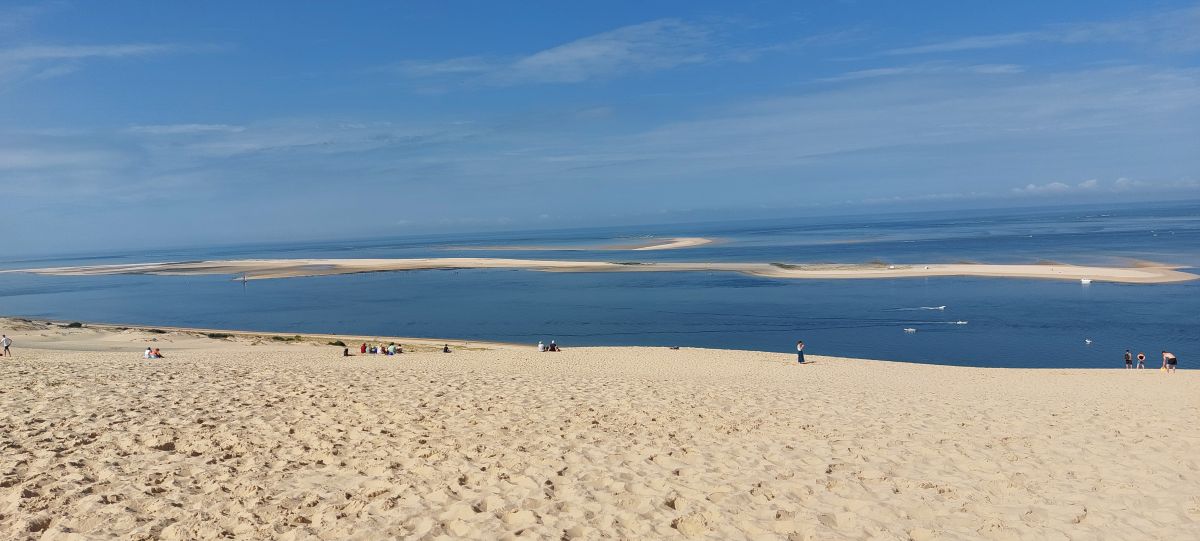
The next day we visited what is arguably the French Atlantic Coast’s most famous natural attraction, the Dune du Pilat.
A friend had warned me, and I am passing the warning on, to go early or late in the day, to avoid the heat. The reason? While the area around the dune is covered in forest, the dune itself is, well, just a very long stretch of sand. And you will have to climb it in the heat.
The Dune du Pilat is absolutely spectacular. At over 100 metres, is the tallest sand dune in Europe, and 2.7 kilometres long.
After the dune, we explored the city of Arcachon itself. Our host had recommended the Ville d’Hiver (Winter Town) with its elegant 19th-century villas and it feels like a journey back to the age of Proust or Napoleon III. I also enjoyed the seaside Ville d’Été (Summer Town) which is nearest the beach. We walked along the beach all the way to Le Moulleau, where a 19th-century chapel (Notre Dame des Passes) overlooks a pretty district of seaside restaurants and cafes and a powdery sandy beach. It is also a great spot to admire the Dune du Pilat from the distance.


Are you intrigued by the charms of Arcachon Bay? Check this post for an in=depth guide.
Day 13 Archachon to Île de Ré (via Cognac)


En route to the Ile de Re, we decided to take a slight detour and visit Cognac. The famous Cognac distillers such as Remy Martin and Hennessy have tasting rooms in town, so we did walkaway with Cognac bought in Cognac.
But it was the city itself that blew me away. This little city in the Charente region, where France’s Renaissance King Francois I was born, is a delight of cobbled alleyways, stone houses and mansions, with a beautiful Gothic church (Saint Léger) and a delightful riverside setting. Whether you like brandy or not, if you are looking for a delightful and not overcrowded French village, Cognac should be on your list!
The drive from Cognac to the Île de Ré bridge, which connects la Rochelle with this low-lying Atlantic island, is only 1 and a half hour. So by dinner time we were tasting our Cognac by the Atlantic ocean!
Day 14 Île de Ré
I have written a post about our stay there, so I will just to summarise why you should visit Ile de Re.
This island is not yet on the global tourist map, probably because the French keep it to themselves. But it is a delight. Think gorgeous beaches, characteristic white-washed villages, and fantastic cycling paths, which means you can park your car at your accommodation and never use it again!

Day 15 Île de Ré
Île de Ré appeals to nature lovers, celebrity seekers (many French stars own houses here), history buffs and fitness holiday fans.
The villages are fascinating, and bear witness to the complex history of this place, that has prospered on salt and wine since days of the Romans. I love Ars-en-de Ré with its iconic church, Portes-en-de Ré with its away from it all vibe (and proximity to the stunning Conche des Baleines beach), Saint-Martin-en-Ré with its marina and UNESCO-Heritage rampars, La Flotte with the athmospheric ruins of a Cistercian abbey…The list goes on. But one thing I have learnt on Ile de re, is that is a state of mind, as well asa place.
It is a place where you can spend a week in communion with the ocean, or a week on an active cycling holiday.
Whatever you do make sure to include a visit to the stunning beach of Conche des Baleines, or to Trousse Chemise, where you can allegedly picnic on a sand bank at low tide (I seemed to always end up there at high tide). The other unmissable experience is a cycle through the incredibly colourful salt marshes, where the term ‘fleur de sel’ will acquire a whole new meaning!

Day 16 Dol Brittany
From Île de Ré we drove on to Brittany. Accommodation was limited in the seaside villages, so we based ourselves in a restored chateau just outside Dol, one of Brittany’s ancient cities.
The centre of Dol is small and easy to visit in an afternoon. Its claims to fame are: that it is the birthplace of the Stuart dynasty that later ruled Scotland and England, and that it was the religious capital of medieval Brittany.
According to legend a Welsh monk called Samson arrived in Dol in the 6th century. and founded a monastery. Upon his death, he was buried in the monastery’s church (now the cathedral of Dol). He would become one of the 7 founding saints of Brittany. By the 9th century, Dol was the religious capital of the Breton king Nomenoë, It remained an episcopal city until the 19th century.
Saint Simson’s church and many subsequent early cathedrals were destroyed and rebuilt. The current, 13th-century Gothic cathedral displays a rather daunting exterior, although softened by graceful sculptures in the porches.
The interior is fascinating. Layers upon layers of Breton history are preserved in the church, from the glass-stained windows to deeply spiritual chapels dedicated to various saints, to the tomb of the 15th-century bishop Thomas James, considered the first example of Renaissance architecture in Brittany.


The church also has a mysterious and somewhat legendary connection to water. There is a well inside the church, connected to a well inside it, and both are fed by a unique source.
According to legend, St Samson had founded its church on a hill with a well. Did the builders of the cathedral decide to include this well in its holy interior, and therefore decided to establish another well outside for the population of Dol? We do not know, but it is a fascinating element in a truly fascinating building!
Outside the town of Dol is another fascinating and mysterious site, Mont Dol.
This small hill was considered sacred by successive cultures that inhabited the area. Inhabited from the Neanderthal period (remains of Paleolithic mammoths and woolly rhinos were found there), it was used by Gallic tribes to worship their god of lightning. The Romans replaced it with the cult of Jupiter, their version of the god of lightning. So the hill’s name was changed to Mont Jovis (the mount of Jupiter. After the area’s Christianisation, it became Mont Joie.
At the top of the mound, the pagan altar was replaced in the 6th or 7th century by a chapel to Saint Michael, now in turns replaced by a chapel dedicated to Mary. A spiral staircase leads to the platform and opens onto a beautiful panorama.
But Saint Michael’s presence hovers in the area thanks to another legend. Mont Dol was the site of a battle between the Archangel Michael and the Devil. Near the chapel, on the edge of the plateau, there is a rock with a hollow on its face. According to legend, this is the footprint left by the Devil before Michael kicked him off the mountain.
The area is linked to Saint Michael in a different way too. When the sky is clear, from the top of the mount you can catch sweeping views of the bay of Mont Saint Michel, and its magnificent island abbey. When I climbed Mont Dol, it was grey, so I cannot testify to that. But hopefully the sun will shine when you go!
Day 17 Dol to Caen


On the last day, we drove to Cancale, one of Brittany’s prettiest seaside towns. The weather wasn’t the greatest, so we went for a walk around town and then continued our drive back to Caen. In Cancale, taking photos of the city, I had an impressionist moment. The shape of a building appeared in the misty distance, an unmistakable building – the Abbey of Mont Saint Michel.
We had already visited the abbey – although with an extra day at my disposal I would have happily revisited it. If you want to visit, you can read my guide to Mont Saint Michel here. But we drove back to Caen slowly, following the coastal route, to catch views of Mont Saint Michel rising from the sea from many angles.
We arrived in Caen in the afternoon, and boarded the evening ferry back to Portsmouth. It was the end of one of my favourite and most epic holidays. We saw all sorts of architecture, Norman, Roman, Renaissance, medieval, Occitanian, Breton. We saw so many natural wonders, from Atlantic tides to marshlands, from cave systems to sinkholes, from islands to dunes; we admired so many of France’s beautiful rivers. I discovered cities like Toulouse and hidden gems like Sees, Dol, Cognac, and Narbonne. Even writing about it makes me want to go back and explore more of France. But for now, au revoir!
Did you enjoy this post? Subscribe to my blog or follow me on social media so you do not miss any post.
You must be logged in to post a comment.