
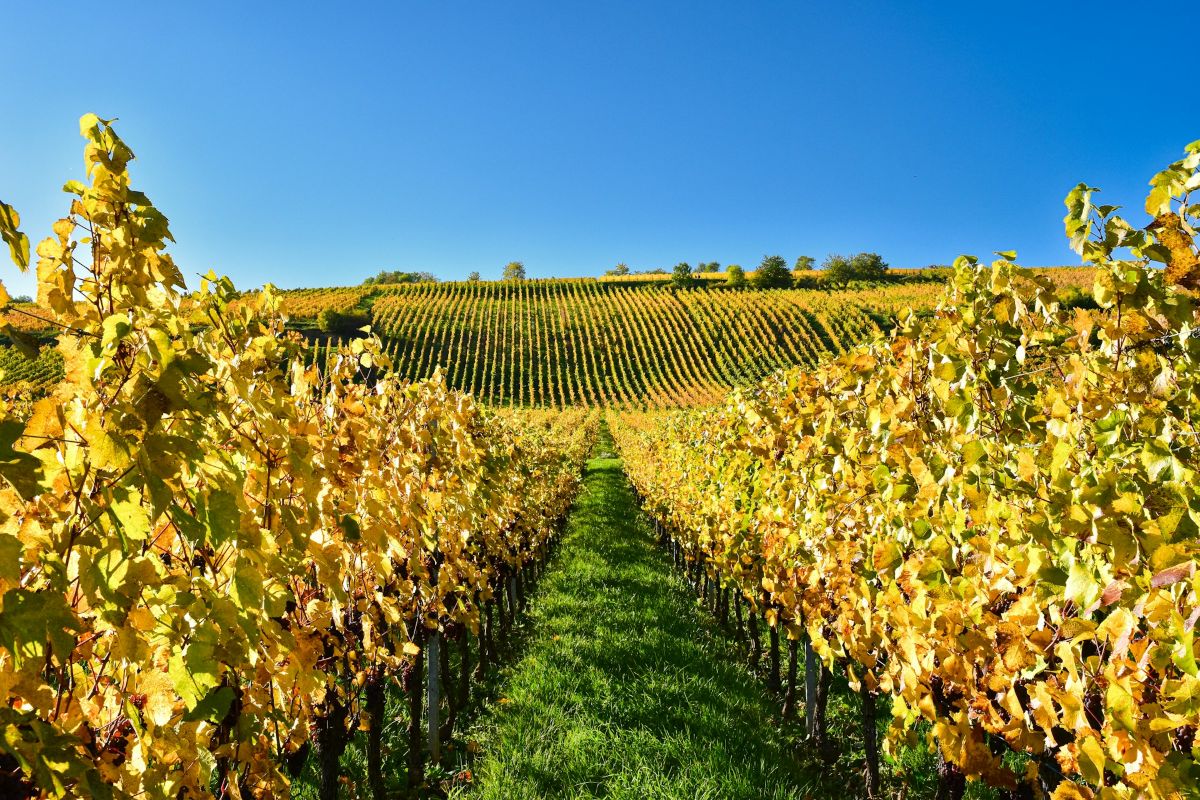
Late sun? Mist? Falling leaves? New wines and delicious food? Whatever your definition of autumn is, there will be a place in France where you can experience it at its very best.
My first experience of France was Paris in autumn, and I loved it so much. The bohemian mood of Les feuilles Mortes or of Verlaine’s lines on the long sighs of autumnal violins ringing in my head, I immersed myself in the Parisian mystique, even in pouring rain!
But there is far more to France than Paris, and France has a great rail network that you can make the most of. This week, SNCF has just opened its bookings for autumn. So it is a great time not just to dream a French escape, but to plan it!
Why go to France in autumn?
France’s best France is a vast country with varied climates, and in early autumn you can still expect glorious sunshine in the deep south, and misty atmosphere’s on the Atlantic or in the north.
The vineyards of Champagne, Bordeaux or Burgundy turn gold and russet, the most popular cities are calmer and less crowded, the Med is still swimmable, and in many cities and villages cultural festivals fill the calendar.
It is also a great time to travel by train. You will find far more offers on high speed trains, and regional trains outside peak commuter times will be less busy.
Best places to visit in France this Autumn
I have handpicked destinations with a different vibe, from cities to remote countryside and mountain regions. The magic of autumn in Paris or Bordeaux is very different from the magic of autumn in the Champagne or in Provence!
Here is the list:
- Paris
- Champagne region
- Cote d’Azur
- Beaujolais
- Bordeaux
- The Loire valley
- Aix en Provence
- Lyon
- Strasbourg and Alsace
- Dijon and Burgundy
Some of these trips are ideal for a flightless long weekend; some others are perfect for a week-long break.
1. Urban foliage in Paris: the Boulevard and the Jardin des Tuileries
Autumn in Paris is truly special. There are trees along many boulevards, so you’ll experience the magic of fallen leaves pretty much everywhere. Actually, my first memory of Paris is coming out of the metro at Place de la Concorde one late September and catching my first sight of the Eiffel Tower rising above a sea of autumn leaves!

an autumn stroll through the Tuileries is a real highlight. This most central of Parisian parks, bordered by Place de La Concorde, Rue de Rivoli and the Seine, is a triumph of foliage.

If you love history, the Jardin des Tuileries used to be the grounds of a long-gone royal palace. Before you, the likes of Napoleon, Louis XIV and Catherine de Medici admired the Passing of the seasons in these beautiful grounds.
I remember a delightful lunch of walnut and roquefort salad in a kiosk under yellowing leaves, with a distant view of the Seine and autumnal light all around. Magical.
Getting there:
You can get to Paris by train from many European capitals. Check RailEurope or Trainline to Plan your trip. Once in Paris, whichever station you have come from, you can get to Les Tuileries by RER train and metro.
2. Foliage and bubbles: Autumn in the Champagne region
I have been lucky enough to visit the Champagne region in all seasons, but the grape harvest season is magical. The energy that will go into the bubbles fills the air. And for when the harvest is over, there is something meditative and beautiful about the rolling hills when the leaves dry up on the vines, painting them gold and russet. It can be misty, it can be crisp and cold, but it is special.

While most trees will be leafless by then, the colours of the hills are fantastic even in December and January.
You can alternate hikes and visits to the cellars with discovering the cultural highlights of this region, which was the birthplace of the Gothic style, and one of the most powerful centres of medieval France. It is a perfect off-season short break. My post about a long weekend between Reims and Epernay will help you plan an itinerary using public transport only.
If you have a week, you can spend a couple of days exploring Reims and a couple of others exploring the delightful villages in La Montagne de Reims, between Reims and Epernay, where most Premier Cru and Grand Cru is grown.
You could also visit the less visited but wonderful Aube champagne growing area, and the city of Troyes, with its beautiful medieval centre.
Getting there:
You can get to Paris by train from many European capitals. Check RailEurope or Trainline to Plan your trip.
The SNCF network will take you to the main centres (Reims and Epernay) and the largest villages.
3. Cote d’Azur without the crowds
When the crowds have gone, it is the perfect time to discover the timeless beauty of the postcard-perfect Mediterranean.
I visited in November once, for a long weekend. I did get a mix of rain and sunshine, but when the sun was shining the light in Marseilles and the Calanques area was incredible, and the early sunsets in Cassis were glorious.

Antibes, Marseilles, and Nice are all great bases. Of the three, Marseille is the best option if you are looking for a vibrant year-round destination. It is a large and multi-cultural city, after all. Antibes and Nice may feel a bit empty off-season, especially during the week I do not mind because it means I get the beauty to myself, but do bear it in mind when planning your trip.

Getting there:
You can get to Paris or Lyon by train from many European capitals. Check RailEurope or Trainline to Plan your trip.
The high-speed SNCF network will take you to Marseilles, Antibes and Nice.
4. The Beaujolais
The new season Beaujolais arrives on the third Thursday of November, so why not go and taste it in its area of origin?
The pretty Villefranche-sur-Saône is the capital of the Beaujolais region and a great base for exploring the area’s picturesque villages and vineyards, and the gentle landscape dotted with chateaux.

Another excellent base is the delightful village of Bois-d’Oingt, in the middle of the picturesque Tuscany-like Val d’Oingt. You can hike, cycle or travel around on the local bus network to visit the other Beaujolais villages, such as the Beaujolais historical heart of Beaujeu.
Beaujeu also hosts the 5-day Les Sarmentelles festival, where a candlelit procession precedes the opening of the first barrel at midnight.

If wine is not your only enogastronomic interest, the local honey and oil are also renowned. The area is also part of the Valley of Gastronomy, a network set up by the regions of Burgundy -Franche-Comté, Auvergne Rhône-Alpes and Provence- Alpes Côte-d’Azur to encourage the appreciation of local food and wine heritage.
Getting there:
Thanks to its proximity to Lyon, it is easy to travel to the Beuajolais by Train from Belgium, the UK, Germany, Italy, and Switzerland on the SNCF, DB, SBB, Lyria, and Trenitalia networks. Check RailEurope or Trainline to plan your trip.
Once in Lyon change for a local train to Villefranche or Bois d’Oingt and then hike, cycle or move around on local buses.
5. Bordeaux
The name itself evoques first class wines, but there is far more to Bordeaux. This vibrant city in the south west of France is just as rich in cultural highlights and architectural gems – its style inspired the re-design of Paris itself in the 19th century!

Explore the cobbled streets of Saint Pierre, the heart of the medieval city, take the obligatory photo at Porte Cailhau and Miroir d’Eau, wonder at the symmetrical elegance of Place de la Bourse, discover some culinary delights at the traditional Marché des Capucins, explore the Maestic Garonne riverbank, with its bridges, either historic (Pont de Pierre) of visionary (Pont Jacques Chaban Delmas), on foot, bycicle, or boat…The list goes on. Check this post for ideas.
If it rains, you can explore the Cité du Vin and learn all about the local grapes and their role in the economy and history of Bordeaux.
Bordeaux is a city that lends itself to be experienced. It is not just a postcard destination, it is lively and lived. This is another reason autumn is a great time to go. When the tourists have gone, it is time to enjoy life like a Bordelais! Besides, it can be quite hot and humid in summer, so autumn and spring are great times to go.
If you stay more than a couple of days, include a day trip to the delightful village of Saint Emilion, which lends its name to one of the most famous Bordeaux vintages. The city is a gem, with an incredible church excavated in the rock and delightful squares. The surviving water fountains whisk you back to a bygone era too. I visited in early September, just before the wine harvest, and although it is certainly not an undiscovered destination it was delightful. The village is so compact, wherever you are the vineyards and the countryside will be a 10-minute walk away.

Getting there:
There are several fast trains a day between Paris Montparnasse and Bordeaux St Jean. The journey takes 2 hours and 13 minutes. To book your trip to Paris from outside france, Check RailEurope or Trainline.
There are direct trains between Bordeaux and Saint Emilion, and they only take 30 minutes. However the train station is 30 minutes from the centre of the village. You can get a taxi from the station, or book an Uber..
6. The Loire valley
The beautiful chateaux of the loire valley are on many people’s bucket lists. So, unsurprisingly, they are very busy year round, but especially so in late spring and summer.
Yet the beautiful natural setting of these chateaux makes them perfect for an autumn visit. Chambord towers above a vast hunting forest; Amboise is encircled by a ring of gentle hills covered in deciduous woods; Chenonceaux‘s spectacular arches straddle a river lined with ancient trees.

Blois is an excellent base as it is served by fast trains and has a lovely old town with a castle and gothic church.
However, I have a soft spot for Amboise. Its centre with its timbered houses is dominated by the imposing royal Chateau, perched atop a rock overlooking the Loire. Connected to the Chateau by a secret underground passage, is Leonardo’s final home, Clos Lucé. recently been re-opened to the public after extensive restoration, it is a wonderful site. Walking around the rooms where Leonardo lived and worked – his kitchen, his studio, his bedroom, is quite an experience. You can stand by the hearth where the Renaissance genius used to warm his hands.! The museum has an interesting collection of Leonardo drawings.
As you would expect from the home of a man who worshipped ‘the book of nature’, Clos Lucé is on the edge of town, and allows you to soak in the changing of seasons.

Chenonceaux is of course magnificent. the fact that it was designed and lived in by two intelligent, educated and powerful women adds to the uniqueness of the architecture. The kitchen gardens are incredible during the season of mellow fruitfulness.!

Getting there:
The trains between Paris and the Loire Valley run from Gare Montparnasse and Gare d’Austerlitz. There are stations at Blois-Chambord (high speed), Amboise, and Chenonceaux.
Check RailEurope or Trainline to plan your trip.
7. Aix and the market towns of Provence
A few years ago I found myself in the centre of Aix-en-Provence on a sunny November morning and discovered their incredible market, brimming with colourful vegetables, jars of honey, quiches, Provençal handicrafts, soaps and wines.
I have since discovered that markets are ubiquitous in Provence, and spread throughout the week. Saint-Rémy-de-Provence‘s on a Wednesday is the largest, Carpentras hosts a truffle market on Fridays from mid-November to the end of March, and the Saturday market of the village of Apt, in the Luberon, has been attracting customers since the 16th century with the flavours of tapenades, apricots jams, and nougats.

If you want to experience the beauty of Provence without the crowds, autumn is the perfect time to go and enjoy it slowly at your own pace, savouring the fresh local produce. And when the days shorten, the bright light of Provence so beloved of the impressionist painters will nourish your heart too!
As a base, I recommend Aix, I love the cream-coloured houses, the grand but slightly decadent squares, the cathedral that feels like a history book, with Roman, Merovingian, and Gothic elements, the other Romanesque churches, the traces of Roman buildings everywhere – the spa of my hotel encapsulated parts of the old Roman thermae…
I can go on forever. The Granet museum houses some magnificent Cezannes, and if you want to see where he drew his inspiration from, you can hike to the beautiful Montagne Sainte Victoire. Past the village of Le Tholonet you will find a mountain hut, the refuge Cézanne, where he liked to paint.

Getting there:
By train, you can get to Aix en Provence TGV from Paris Gare de Lyon in just over 3 hours. Check RailEurope or Trainline to plan your trip from the rest of Europe.
Aix en Provence TGV is actually quite far from the centre of town, so you will need to get on a shuttle bus or taxi to the centre. If you are arriving from Marseilles, book a regional service so you will arrive in the smaller station in the centre of Aix.
8. Lyon
When the weather turns cooler in the capital, it is the perfect time to visit France’s second largest city. Lyon tends to be overlooked, in favour of Paris, Yet it is a gem. Think Impossibly blue skies, pastel-coloured buildings, elegant architecture, old world-class blended with contemporary creativity and a touch of irony. Despite these charms, tourist numbers do not exceeding residents as is often the case in the most famous European destinations. This means Lyons retains a relaxed vibe.
What makes it perfect for an autumn break? I have already mentioned that it is much warmer than Paris. Autumn is mellow and the golden light just makes is city of cream and ochre architecture even more magical. But that is not all. The natural features of the city make a real difference. Lyon is dominated by a hill, and boasts one but two rivers crossing the city centre!

Lyon is a city for walkers, and I would argue for climbers – la Fourviere hill, in the Middle of the city, with a beautiful basilica and Roman ruins on top is perfect for enjoying urban foliage and offers sweeping vistas not just of the city below and of the hills around Lyon, but also of the Alps. You will make out Mont Blanc rising in the distance.
make sure you walk along both the Rhone and the Saone. The rivers are so close and yet so different, and the redevelopment of the river banks means you can really appreciate nature right in the heart of the city.

The cobbled streeets and traboules of Le Vieux Lyon are another treat. If all the walking made you hungry, Le vieux Lyon is also a great place for a hearty meal. Lyon boasts the highest concentrations of Michelin-starred restaurants pro capita in Europe! So if you fancy a treat it is a great place.
Museums are also excellent. This post gives you an idea of what Lyon offers and tips for planning your visit.
Getting there:
By train, the SNCF and Trenitalia high-speed network will get you to Lyon directly From Paris (2 hours), Brussels (£ hours), Torino (4 hours) and Milano (5 hours). Check RailEurope or Trainline to plan your trip from the rest of Europe.
9. Strasbourg and Alsace
Strasbourg hosts one of France’s (and Europe’s) most famous Christmas markets, and the postcard perfect Alsatian villages such as Colmar and Eguisheim do the same. So winter is peak season in Alsace.
This is why autumn is an ideal time to visit. You will not experience the magic of an Alsatian Christmas, but you will enjoy Alsatian hospitality and enjoy the sights and the delightful food and wine in complete relaxation. It is also a great time to hike the gorgeous and hilly Alsatian countryside.
If you only have time for a city break, limit yourself to Strasbourg. There is a lot of magic to soak in around this great historic city. In its UNESCO-Heritage-listed Old town, called la Grande Île (Big Island), You will find magical corners such as the covered Bridges (above), and the a delightful maze of half-timbered houses and cobbled streets, known as Petite France (Little France.).

The cathedral iis hailed as a gothic masterpiece, and absolutely magnificent for its proportions and intricate sculpture. It is deservedly considered one of Europe’s most beautiful medieval cathedrals.

Strasbourg’s present is as interesting as its past. It is the seat of the European Parliament, which you can visit throughout the year..
If you have more than a long weekend, there is so much else to explore in Alsace. The pretty village of Colmar, the epitome of poscard perfect Alsace, is a short train ride away. Another interesting village is Eguisheim. (16 minutes by bus).
If the centre of Strasbourg charmed you with its medieval beauty, you may want to visit one of Alsace’s iconic medieval castles. A 37-minute train ride (or 11-minute from Colmar) takes you to Sélestat. From there, in 30 minutes, buses take you to the 900-year-old Haut-Koenigsbourg castle, perched on top of a mountain overlooking the Rhine valley.

Getting there:
By train, the SNCF high-speed network will get you to Strasbourg directly From Paris Gare de l’Est (2 hours) as well as from Basel in Switzerland. Check RailEurope or Trainline to plan your trip from the rest of Europe.
10. Dijon and Burgundy
Burgundy is one of the most famous wine regions on earth, and as you would expect it gets plenty of visitors during the summer and wine harvest season. Things calm down in autumn, but the charms of the area do not go away!
a former duchy and before that an independent kingdom, Burgundy has an incredibly rich history and sights to match!
Dijon is its worthy capital. brimming with building ranging from medieval Gothic (the cathedral of Saint Bénigne) to Art Deco. the historic Palais des Ducs, doubles up as one of France’s great museums, the Musée de Beaux Arts.

Autumn is a great time to walk through the ancient streets to soak in the atmosphere. If you are looking for epicurean experiences, the Cité Internationale de la Gastronomie et du Vin teaches you all about the local culinary and enologic glories.
Surrounded by vineyards, Dijon is the starting point of the route des Grands Crus, where eight of the world’s top ten most expensive wines are produced.

If you have more than a couple of days, the Route des Grand cru ends in Beaune. It is a smaller but delightful city, with spectacular architecture and, off season, a very peaceful vibe. Rent a bicycle and explore the countryside at your own pace!

Getting there:
Direct trains from Paris Gare de Lyon to Dijon take one and a half hour. For Beaune, change in Dijon for a regional train (18 minutes) Coming from somewhere else in Europe? Check SNCF or RailEurope to plan your trip.
Once in Lyon change for a local SNCF train to Villefranche or Bois d’Oingt and then hike, cycle or move around on local buses.
Planning your journeys
If you intend to travel onward from your French destination, RailEurope is probably the best site to use as it allows you to buy train travel passes rather than just one-way or return journeys. Alternatively, Trainline is a reliable option. From London, you can book your trip to Paris with Eurostar and then book local travel on SNCF.

Stay in touch
I hope you have enjoyed my post on France’s best Autumn destinations. My Autumn Train travel series continues next week, with an Italy special.
don’t forget to subscribe to my blog to receive next week’s post straight into your inbox.
You must be logged in to post a comment.